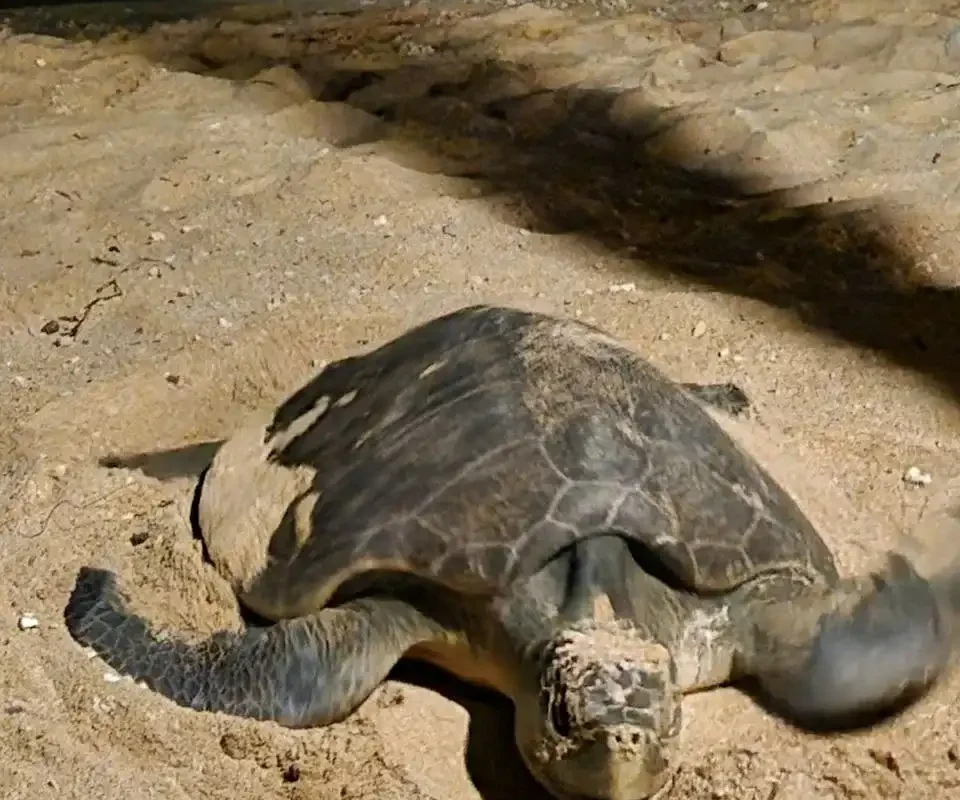
Sea turtle nesting looks like a slow, quiet scene on a dark beach, but almost every part of it is a feat of biology. In plain terms, sea turtle nesting is the process in which an adult female crawls ashore, digs a flask-shaped chamber in the sand, lays around a hundred eggs, buries them, and returns to the sea, leaving the sun-warmed sand to do the rest. Three things make it remarkable: the navigation that brings a female back to the beach where she hatched decades earlier, the sand itself, which decides whether her babies will be male or female, and the hatchlings’ first night, when they must find the ocean on their own.
I watched a female cover her nest on the south coast of Sri Lanka and, on other evenings, saw hatchlings scramble toward the waves. Every photo here is my own. If you are looking for the practical side, where and when to go on the island and which hatcheries to avoid, read my guide to sea turtles in Sri Lanka. This article is about what actually happens on the beach, step by step.
Step 1: the journey home
Long before a turtle reaches the beach, she has made one of the great journeys of the animal world. Most sea turtles spend years, often decades, feeding far from where they were born. Green turtles, for example, may need 20 to 30 years or more to mature. Then, when a female is ready to breed, she travels back to the general region, and often the very same stretch of coast, where she hatched.
Scientists call this natal homing. The leading explanation is that hatchlings “imprint” on the unique magnetic signature of their home beach. Earth’s magnetic field varies slightly along every coastline, in both strength and angle, and a turtle appears to remember those values for life, the way we might remember a street address. Years later, she follows the magnetic map back. Near the coast, smell and other cues probably help her with the final approach.
Mating happens offshore, weeks before nesting. A female can store sperm and will usually lay several clutches in one season, coming back to the beach every 10 to 15 days or so. Then she may skip one or several years before nesting again. That is why a single beach can see the same turtle on different nights in one season and then not at all the next year.
Step 2: the crawl up the beach
On most beaches, sea turtle nesting nearly always begins after dark, often around high tide, when the turtle has less dry sand to cross. In the water she is graceful. On land she is heavy and slow, hauling her body forward with her front flippers and stopping often to rest. Each species leaves a different track: green turtles move both front flippers together, leaving a symmetrical, “butterfly” trail, while hawksbills, loggerheads and olive ridleys alternate, leaving a zigzag track.
This is the moment when a female is most easily put off. Lights, movement, noise or people on the sand can make her turn around and go back to the sea without laying. Biologists call this a “false crawl”. Turtles also abandon attempts naturally, when they hit roots, rocks or sand that is too dry to hold its shape. A few false crawls are normal. Many, on a crowded or brightly lit beach, are a sign of trouble.
She keeps going until she is above the high-tide line, where the eggs will not be flooded, but usually not so far inland that the hatchlings will get lost among vegetation. Choosing that strip of sand is one of the most important decisions of her life.
Step 3: the body pit and the egg chamber
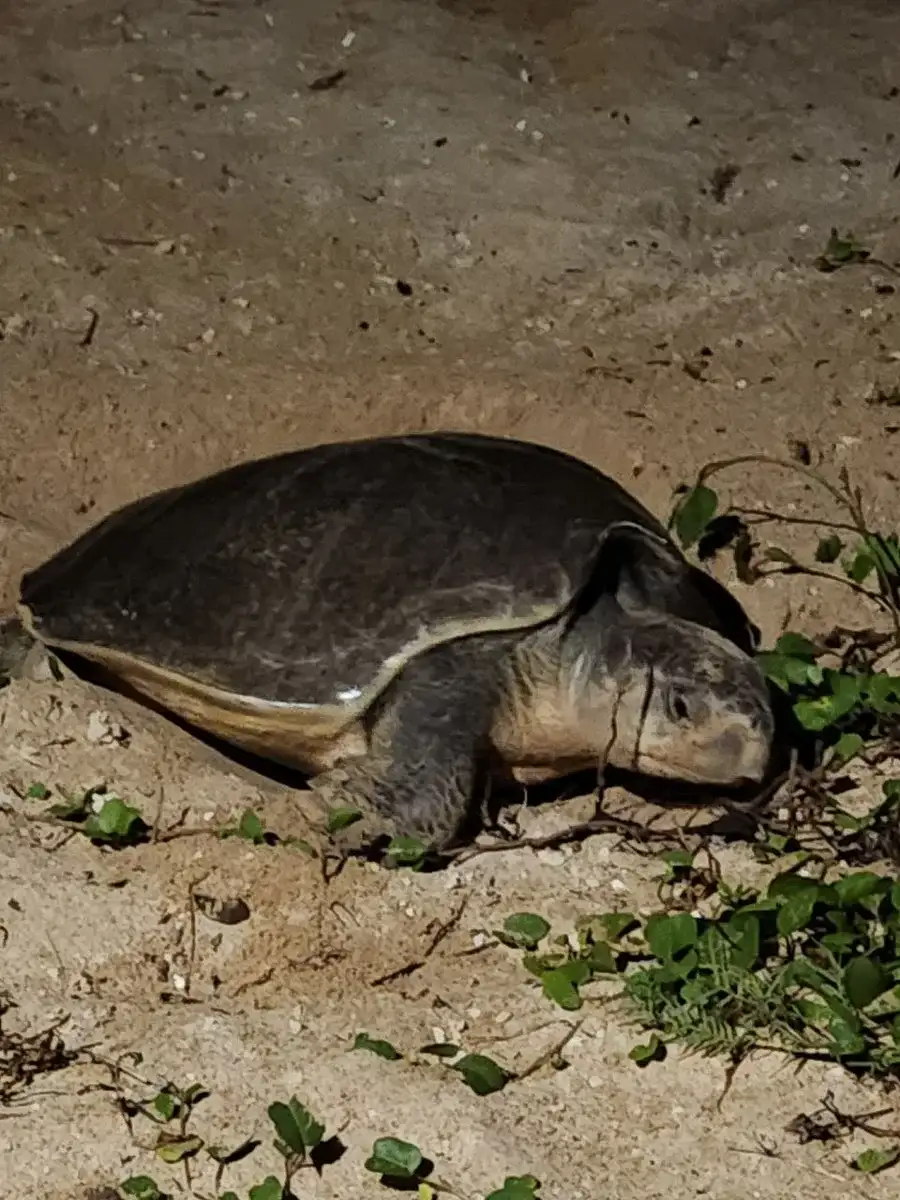
Once she has picked a spot, the female sweeps away the loose, dry surface sand with all four flippers, sinking slowly into a shallow hollow called the body pit. This brings her down to the cooler, damp sand underneath, which holds its shape.
Then the real work begins, and it is done entirely by touch. Using only her rear flippers, one at a time, she scoops out a narrow, flask-shaped hole beneath her tail. Each flipper curls like a cupped hand, lifts a little sand, and drops it to the side, while the other flipper presses down on the rim so the walls do not collapse. She cannot see what she is doing. The finished egg chamber is usually around 16 to 30 inches (40 to 75 cm) deep, depending on the species and the length of her flippers.
When the chamber is the right depth, she stops. Exactly how she knows is still something researchers discuss, but it seems to be the moment her flipper can reach no further.
Step 4: laying the eggs
This is the heart of sea turtle nesting. Now the eggs come, usually in twos and threes, dropping into the chamber with a little coating of mucus that keeps them moist and cushions the fall. A typical clutch is around 100 eggs, roughly the size and shape of ping-pong balls, with soft, leathery shells that dent rather than crack. Leatherbacks also lay a number of small, yolkless “spacer” eggs, whose purpose is still debated.
During laying, many females fall into a kind of trance and become less sensitive to their surroundings. This is the stage when trained guides sometimes allow quiet observers to come close, with no lights in the turtle’s eyes. You may also see what look like tears. Turtles do not cry from emotion. They have salt glands near their eyes that constantly remove excess salt from their bodies, and on land the secretion is simply easier to see.
Step 5: covering and camouflage
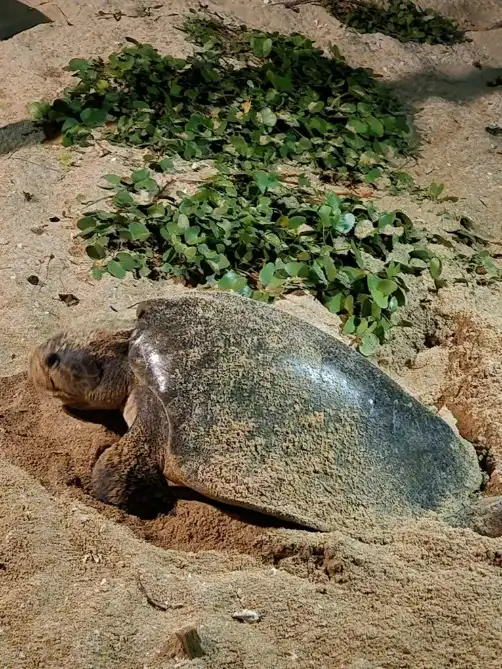
After the last egg, the female fills the chamber with her rear flippers, packing the sand down firmly with her body. Then she does something that surprises many first-time observers: she moves forward and throws sand in all directions with her front flippers, sometimes for half an hour or more, leaving a wide, messy area of disturbed sand.
This is camouflage. A predator, or a human egg collector, sees a large churned patch with no obvious center, and the nest could be anywhere inside it. When I watched, the turtle was half-buried in her own pit, flinging sand with slow, heavy strokes, completely absorbed in the task.
When she is done, she turns and crawls back to the sea. The whole process of sea turtle nesting, from the first crawl to the return, usually takes one to three hours. She never comes back to check. From this moment, the eggs are on their own.
Step 6: the sand decides
For the next six to nine weeks or so, depending on the species and the warmth of the sand, the eggs incubate quietly underground. The sun is the only heater, and it does more than speed up development.
Here sea turtle nesting differs from bird nesting in a surprising way. Sea turtles have temperature-dependent sex determination. Their sex is not fixed by chromosomes but by the temperature of the sand during the middle part of incubation. Warmer nests produce mostly females, cooler nests mostly males. The “pivotal” temperature that produces a roughly even mix is close to 84 to 86°F (29 to 30°C) for many populations. Even the position of an egg in the chamber matters: eggs near the warmer top can develop differently from those at the cooler bottom.
This is why rising temperatures worry turtle researchers. On some hot beaches around the world, the vast majority of hatchlings are already female. Shade from beach plants, darker or lighter sand, and rainfall all shift the balance. It is also one of the reasons careless hatcheries, where eggs are reburied in unshaded or overheated sand, can do more harm than good.
Step 7: hatching and the climb out
When the babies are ready, they break the shell with a tiny temporary tooth on the tip of the snout, called a caruncle, which falls off soon afterwards. They do not climb out one by one. The hatchlings in a nest wait, wriggle and work together: those on top scrape sand from the ceiling, those below trample it down, and the whole group slowly rises toward the surface over several days.
Near the top, they pause. If the sand is still hot, they wait. Cooler sand signals that it is night, when predators are fewer and the hatchlings will not overheat. Then, often all at once, dozens of them boil out of the sand in what researchers call an emergence.
Step 8: the race to the sea
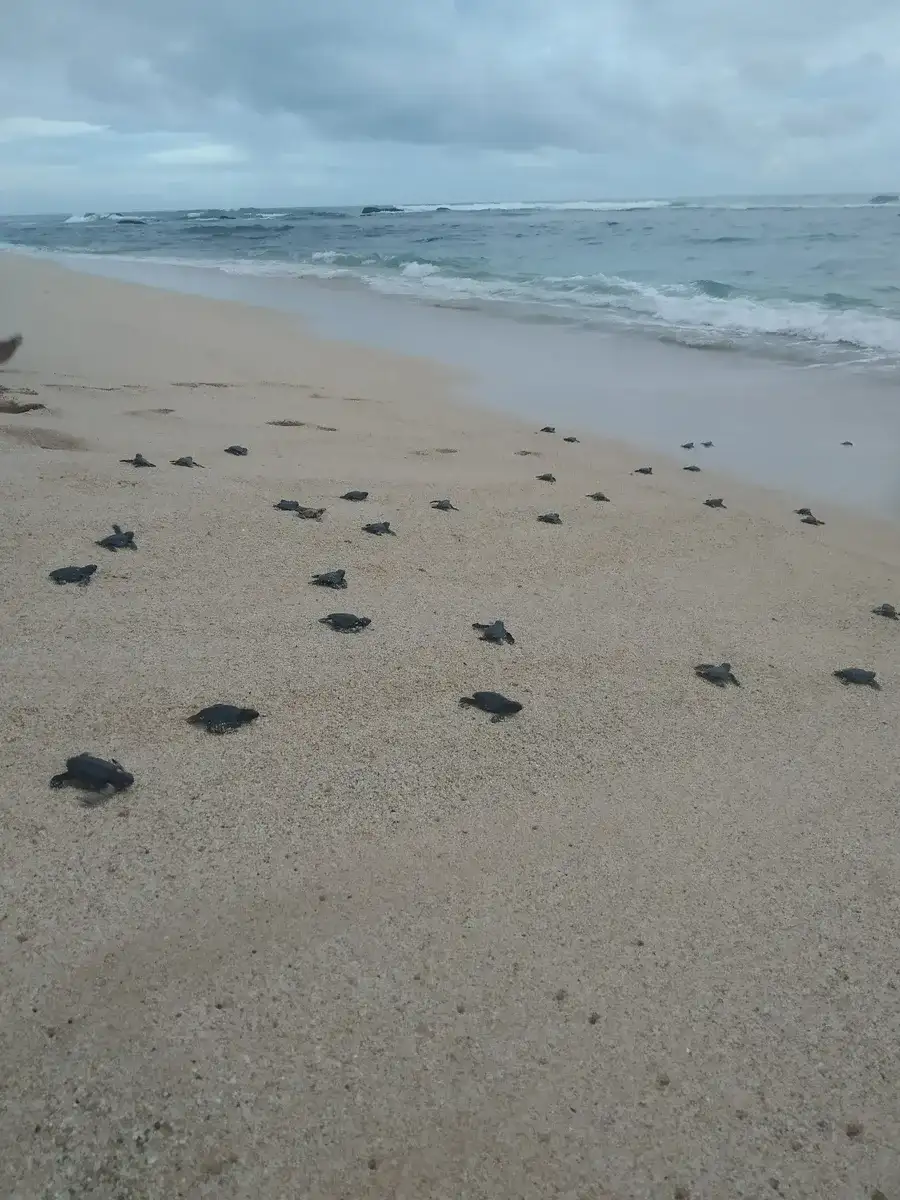
Hatchlings find the ocean by light. On a natural beach, the sea horizon is the brightest part of the night, open and low, while the land side is darker, with dunes and trees. The babies crawl away from the dark shapes and toward the low, bright horizon. Artificial lights, from hotels, streetlights or phone screens, confuse them, and they may crawl inland and die of exhaustion or be caught by crabs, birds or dogs.
The crawl itself matters. Scientists believe the walk across the sand, together with the first minutes in the waves, helps hatchlings imprint on their home beach. That is one reason why carrying hatchlings straight to the water, or releasing them from buckets, is discouraged by conservationists, even with good intentions.
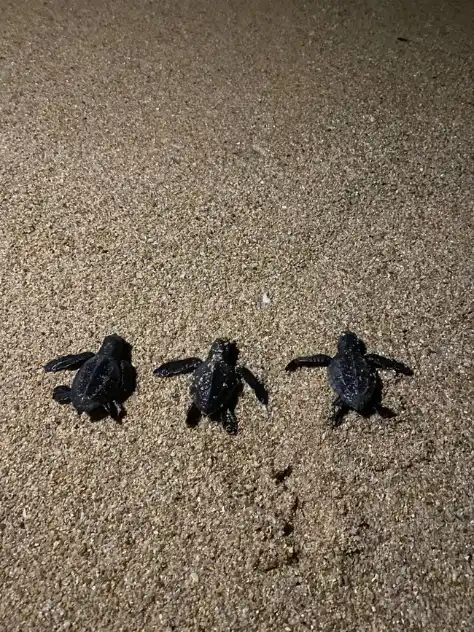
I watched hatchlings make this journey at sunset, tiny dark shapes moving in short bursts, stopping, and moving again. The waves knocked some of them back, and they simply turned and tried again.
Step 9: the frenzy and the lost years
Once in the water, hatchlings swim almost nonstop for a day or more, a burst of energy called the swimming frenzy, powered by the leftover yolk in their bellies. They swim against the incoming waves, which guides them away from the shore, and then use the Earth’s magnetic field to steer.
After that, they vanish. For years, young turtles drift and feed in the open ocean, often among floating seaweed, and are very rarely seen. Researchers call this period the “lost years”. Only when they are larger do many species move back toward coastal feeding grounds.
The odds are harsh. Estimates vary, but a figure often quoted is that around one hatchling in a thousand survives to adulthood. That is why every undisturbed nest matters, and why sea turtle nesting beaches are protected in so many countries.
Sea turtle nesting at a glance
| Stage | Typical duration | What happens |
|---|---|---|
| Crawl up the beach | 10–30 minutes | Female leaves the surf and finds dry sand above the tide line |
| Body pit | 15–30 minutes | Loose sand swept away with all four flippers |
| Egg chamber | 15–30 minutes | Flask-shaped hole dug with rear flippers only |
| Laying | 10–20 minutes | Around 100 eggs, often in a trance-like state |
| Covering and camouflage | 30–60 minutes | Nest packed and the area scattered with sand |
| Incubation | about 6–9 weeks | Sand temperature sets the sex of the hatchlings |
| Emergence | one night, often after days of digging | Hatchlings climb out together and race to the sea |
How to watch without disturbing it
Most of what helps the turtles is simple: keep the beach dark and quiet, and give her space. Never shine a flashlight or phone at a turtle that is crawling or digging. Do not use flash at any stage. Stay behind her, out of her line of sight. Never touch the turtle, the eggs or the hatchlings, and never pick hatchlings up to “help” them. Keep to the wet sand when walking at night so you do not step on unseen nests, and fill in holes and remove sandcastles before you leave, because they trap hatchlings.
The best way to see sea turtle nesting is with a community or scientific turtle watch, where trained guides find the turtle first and tell you when it is safe to approach. For specific places on the island and how to recognize a responsible project, see my guide to sea turtles in Sri Lanka.
Frequently asked questions
How long does sea turtle nesting take?
From the moment the female leaves the water until she returns, sea turtle nesting usually takes one to three hours. Digging and covering the nest take the longest, while the eggs themselves are laid in about 10 to 20 minutes.
How many eggs does a sea turtle lay?
A typical clutch is around 100 eggs, though it varies by species and individual. Most females lay several clutches in one season, returning to the beach roughly every two weeks.
Do sea turtles return to the beach where they were born?
Often, yes. Through natal homing, females tend to return to the region, and frequently the same stretch of coast, where they hatched. Researchers believe they use the Earth’s magnetic field to find it.
What decides if a baby turtle is male or female?
The temperature of the sand. Warmer nests produce mostly females and cooler nests mostly males, with the switch point for many populations close to 84 to 86°F (29 to 30°C).
Why do sea turtles cry when they lay eggs?
They are not crying from emotion. Sea turtles have salt glands near their eyes that remove excess salt, and the secretion is simply easier to see when the turtle is on land.
The quiet miracle on the sand
Sea turtle nesting is easy to miss. It happens at night, it is slow, and the turtle leaves before morning. But behind that quiet scene is a journey across oceans, a magnetic memory that lasts decades, a nest dug by touch alone, and sand that decides the future of every egg. If you ever get the chance to watch it, keep your light off, stay still, and let her finish. You will be seeing something that has happened on beaches for more than a hundred million years.