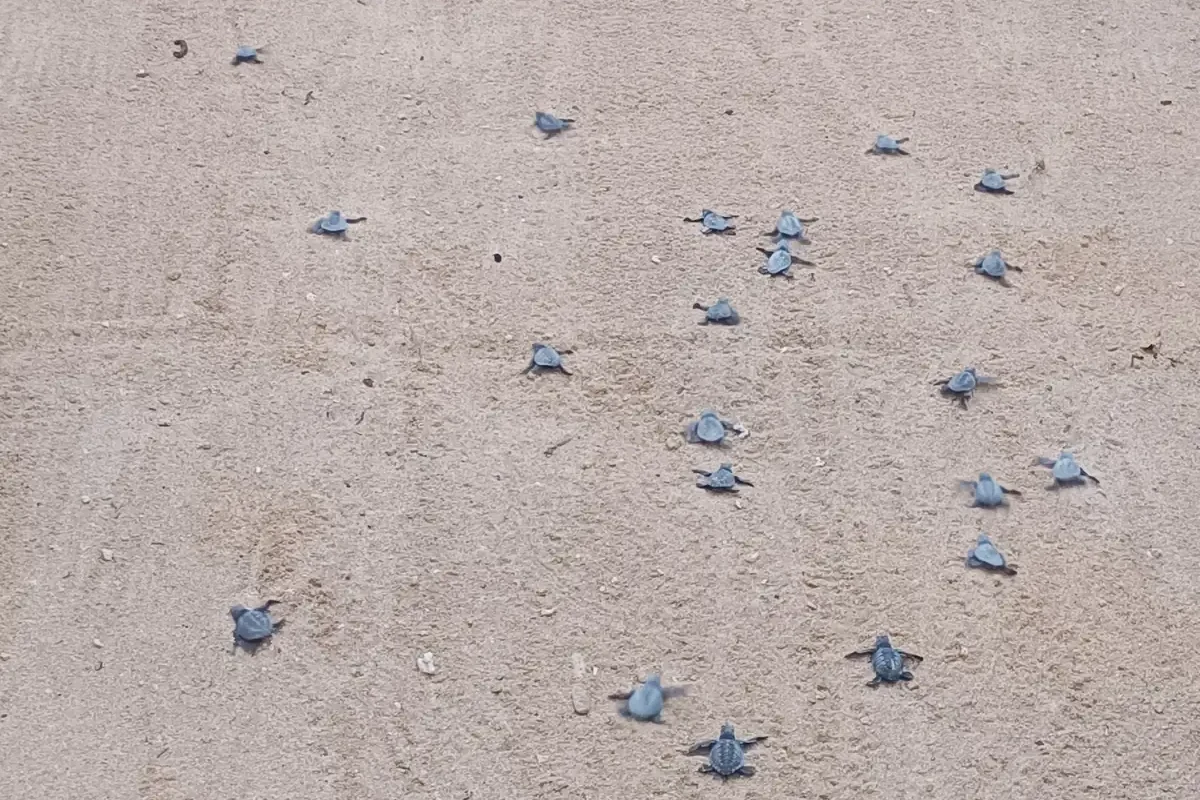
When people ask where to see sea turtles in Sri Lanka, the honest answer is that the choice is between two completely different things: a wild nesting beach where a female comes ashore on her own schedule, and a roadside hatchery where turtles are kept in tanks. They are not variations of the same experience, and only one of them helps the turtles.
Five species nest on Sri Lankan beaches — more than almost anywhere else of comparable size. What decides whether you actually see one comes down to three things: the beach, the season, and the hour of the night.
Five of the world’s seven sea turtle species come ashore on Sri Lanka’s beaches to nest. That is a genuinely rare concentration, and it’s why turtle watching appears on almost every south coast itinerary. It’s also why a large number of roadside “turtle hatcheries” have appeared along the same stretch of coast, and those two things are not the same experience at all.
Accurate as of August 2026. Nesting seasons vary year to year and site access can change. Confirm current conditions locally before travelling specifically for turtles.
Seeing sea turtles in Sri Lanka: the three things that decide it
1. The beach
Nesting by sea turtles in Sri Lanka is not spread evenly along the coast. It concentrates on a handful of dark, undeveloped stretches of sand — Rekawa near Tangalle above all. Beaches with hotels, lights and noise get almost nothing, because artificial light disorients both nesting females and hatchlings heading for the sea.
2. The season
Sea turtles in Sri Lanka nest at Rekawa year-round, which is unusual, but the peak runs roughly April to July, when something in the order of 5–15 turtles come ashore on a given night. Outside that window you may still see one, but you are relying on luck rather than numbers.
3. The hour
Females come ashore after dark, and organised watches work around that. Organised watches at Rekawa run roughly 8:30 pm to 11:30 pm, and you wait on the beach until a spotter finds a turtle. There is no schedule and no guarantee — this is the part travelers underestimate.
The five species that nest in Sri Lanka — at a glance
| Species | How common here | Adult size | What marks it out |
|---|---|---|---|
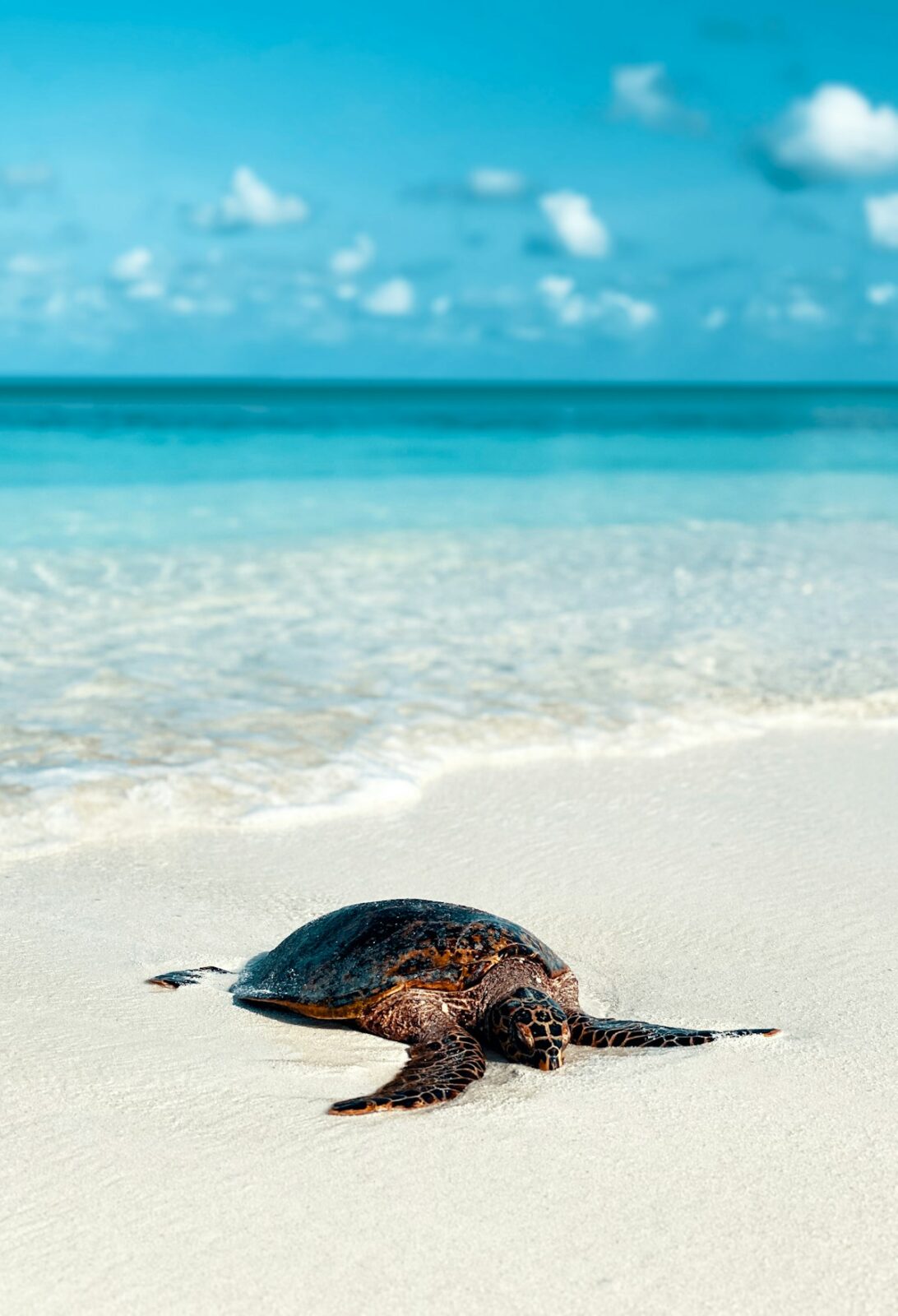
| Green turtle | The most frequently seen nester | Up to ~1.2 m | Largest hard-shelled species here; adults feed on seagrass |
| Olive ridley | Common | Around 0.7 m | Smallest of the five; olive-grey heart-shaped shell |
| Hawksbill | Less common | Around 0.9 m | Narrow beak-like jaw; historically hunted for its shell |
| Loggerhead | Rare | Around 1 m | Oversized head and jaws built for crushing shellfish |
| Leatherback | Rarest, and the most extraordinary | Up to ~2 m | No hard shell — a leathery ridged back; the largest sea turtle on earth |
The Sinhala word for turtle is kasbewa, and a nesting beach is often referred to simply as a kasbewa beach. Guides at Rekawa use English species names with visitors, so you do not need the vocabulary — but it is what you will hear among the spotters.
Species profiles: what you might actually see
All five are threatened to some degree, and all five are protected under Sri Lankan law.
| Species | Roughly how large | Notes |
|---|---|---|
| Green turtle | Up to ~1.2 m | The most commonly seen nesting in Sri Lanka |
| Olive ridley | ~60–70 cm | Smallest of the five here |
| Hawksbill | ~90 cm | Narrow beaked head; historically hunted for its shell |
| Loggerhead | ~1 m | Large head, powerful jaws |
| Leatherback | Up to ~2 m | The largest sea turtle on earth; rare, no hard shell |
When sea turtles in Sri Lanka nest, and when they hatch
These are two different events with two different seasons, which trips up a lot of visitors who arrive expecting both.
- Nesting peak: April to July. This is when females haul out at night to dig and lay. At the main sites, several turtles a night is normal in season.
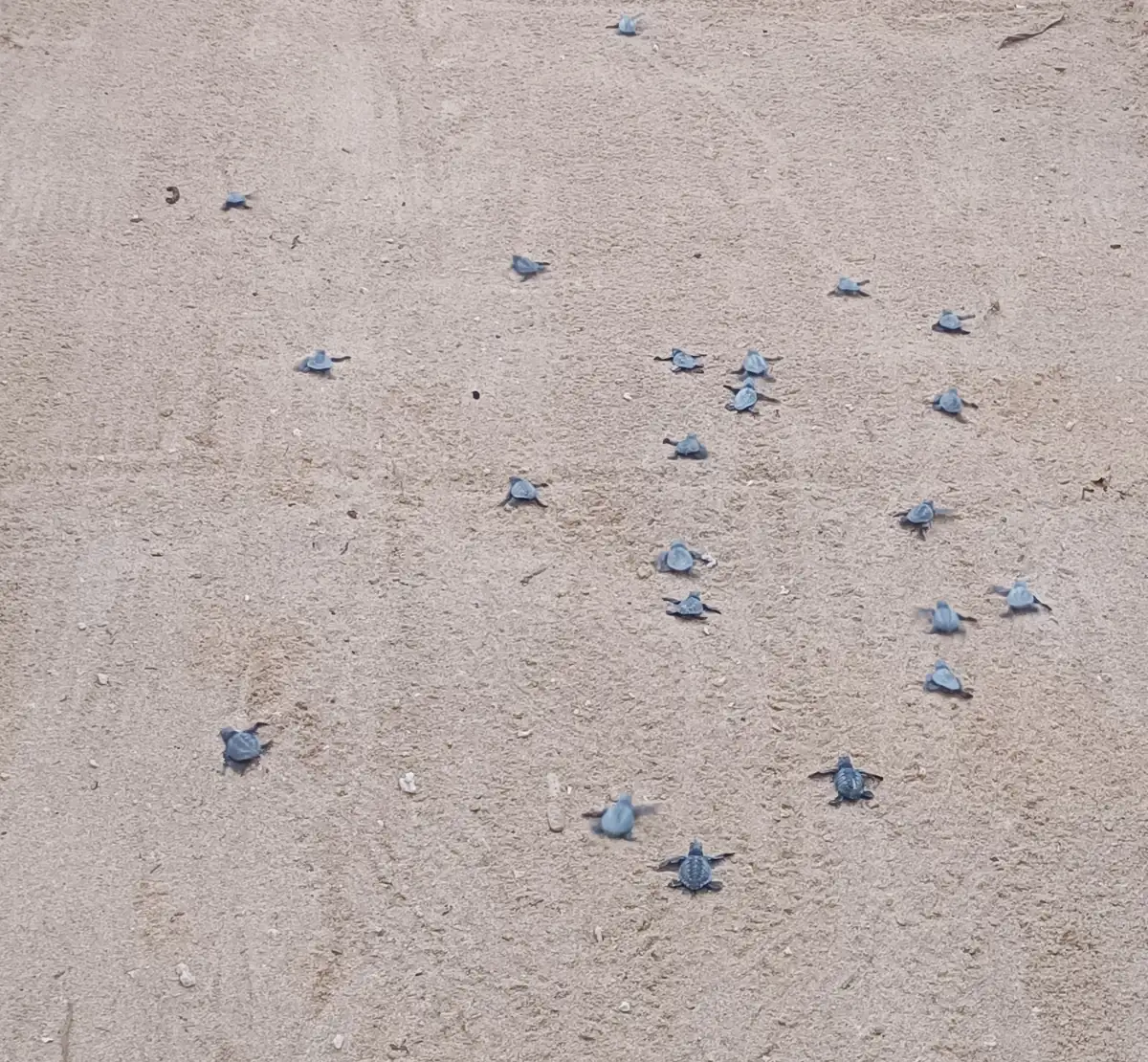
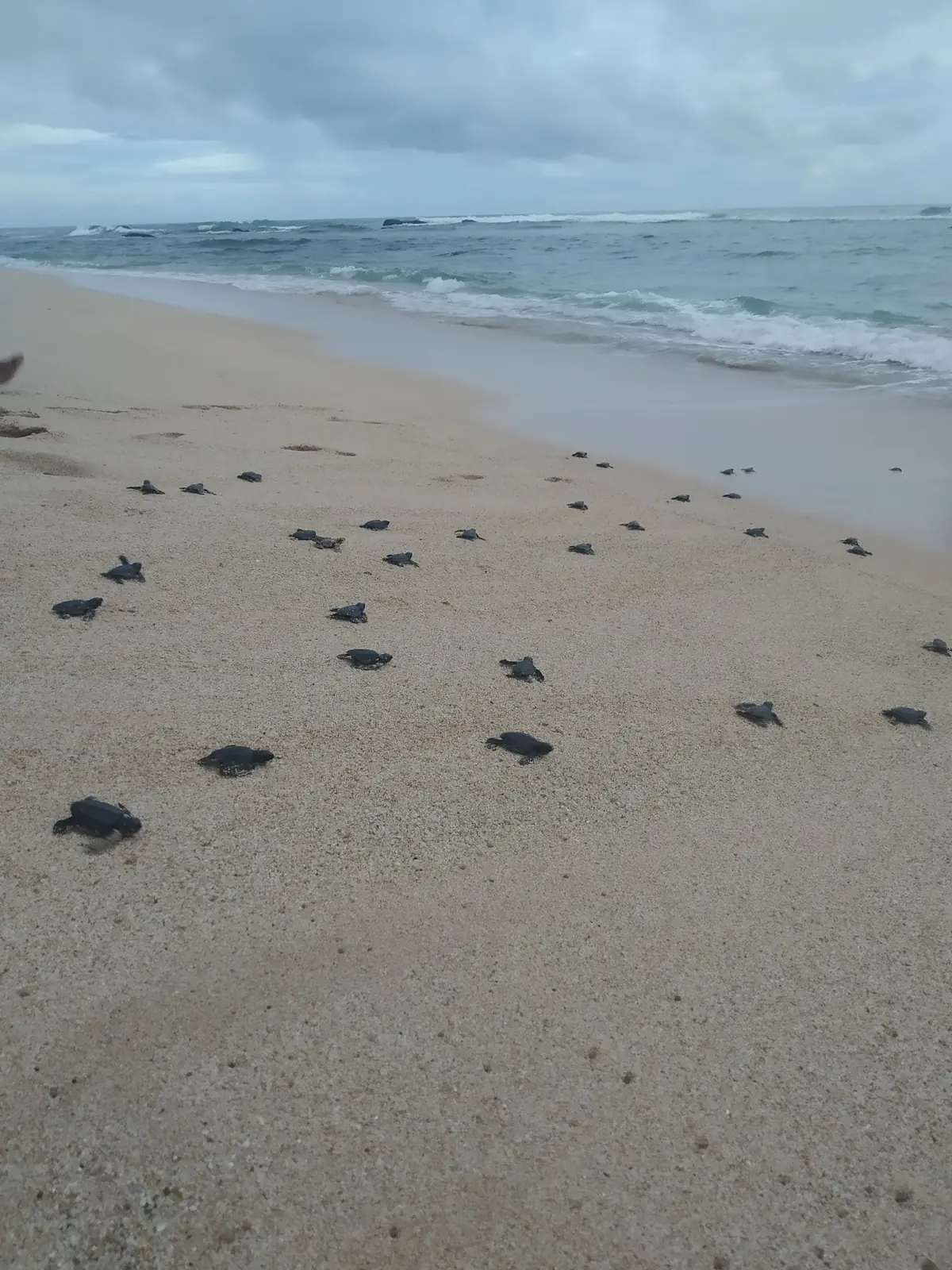
- Hatching peak: June to September. Eggs incubate around two months, so hatchlings emerge after the nesting peak.
- Year-round activity. Both nesting and hatching happen in smaller numbers outside these windows, so a visit in any month can work; it’s just less reliable.
What a nesting night actually looks like
A nesting night follows the same sequence every time, and knowing it makes the wait far less confusing:
- You wait in the dark. No white light at all. Spotters patrol the sand; visitors sit and wait, sometimes for two hours, sometimes for ten minutes.
- She hauls out. A female drags herself up the beach above the tide line — slow, heavy, and audible before it is visible.
- She digs. First a body pit, then a narrow egg chamber dug with the rear flippers alone. This is the point at which she becomes largely unresponsive to what is happening around her.
- She lays. Only now are visitors brought close, because a laying turtle will not abandon the nest. Red light only.
- She covers and leaves. She fills the chamber, disguises the site, and returns to the water. The whole process takes one to two hours.
The rule that visitors are only brought forward once laying has begun is not a formality. A female disturbed during the approach or the digging will turn around and go back to the sea without nesting — a wasted trip for her, and one fewer nest on that beach.
Rekawa: the site that does it properly
Rekawa is a fishing village roughly 8 km from Tangalle on the south coast, and its beach is one of the most important nesting sites on the island. The Rekawa Turtle Conservation Project runs nightly turtle watches there during the season.
What makes Rekawa different is that it’s in-situ conservation. The turtles nest on the natural beach, and the project protects the nests where they were laid, rather than digging eggs up and moving them into tanks. Rangers patrol against poaching, and visitors are taken down to the beach in small groups when a turtle has actually come ashore.
The rules exist for good reason and are enforced: no flash photography, no touching, no white light. Guides use red torches, because sea turtles and hatchlings navigate by light and white light disorients them badly.
Two things to set expectations. First, this is wild wildlife watching, so sightings are not guaranteed and you may wait a couple of hours. Second, it happens late at night on a dark beach, which is worth thinking about with young children.
The context makes the project more impressive: in earlier decades close to 100% of eggs laid at Rekawa were harvested for sale or consumption, meaning effectively no hatchlings from these beaches at all.
Why the Rekawa model works
The in-situ project protecting sea turtles in Sri Lanka at Rekawa began in 1996, and its central idea was economic rather than sentimental: it employed the former egg poachers as the nest protectors.
That detail explains why it has lasted. Egg collecting was income, not malice. Replacing that income with a job guarding the same nests removed the reason to dig them up, and gave the village a direct financial stake in the beach staying dark and undeveloped. Visitor fees fund the patrols. It is one of the few conservation setups in the region where the interests of the community and the turtles genuinely point the same way.
Turtle hatcheries: the part people get wrong
Along the west and south coasts, particularly around Kosgoda, Bentota and Induruwa, you’ll pass a series of privately run “turtle hatcheries” offering tanks of turtles and, for a fee, the chance to hold a hatchling or release one at sunset.
Some of these are legitimate conservation operations. Many are not, and the sector has been repeatedly flagged by marine biologists as unregulated. The recurring concerns are consistent:
- Eggs relocated unnecessarily. Moving eggs into hatchery tanks can alter incubation temperature, which determines the sex of the hatchlings. Poorly managed relocation can skew a whole generation.
- Hatchlings held back. Hatchlings should reach the sea immediately; that first dash builds strength and imprints the beach. Keeping them in tanks for days so tourists can see them reduces survival odds.
- Daytime releases. Releasing at midday, when tourists are present, exposes hatchlings to birds and heat. Natural emergence is usually at night.
- Handling. Passing hatchlings around for photographs stresses them and risks injury.
- Permanently captive adults. Some sites keep large turtles in small tanks indefinitely as an attraction.
Why tanks are the problem — the specifics
Criticism of hatcheries holding sea turtles in Sri Lanka is often vague. The specific mechanisms matter, because they are what separate a bad operation from a defensible one:
- Retention weakens hatchlings. Hatchlings emerge with a yolk reserve that fuels a hard swim offshore. Held in tanks for days, they burn that reserve going nowhere, and enter the sea slower and more easily eaten.
- It may disrupt imprinting. The first crawl down the beach and the swim out are thought to be when a hatchling registers where it came from. Skip that, and its ability to return to the same beach as an adult may be compromised.
- Adults in small tanks. Full-grown turtles kept in concrete pools that do not allow them to swim or dive are not being rehabilitated; they are exhibits.
- Handling. Hatchlings passed around for photographs get dropped, overheated and stressed.
- Daytime releases. Releasing at a convenient hour for visitors rather than after dark hands the hatchlings straight to birds.
- Skewed sex ratios. Sea turtle sex is set by incubation temperature. Relocated nests in uniform hatchery sand can produce heavily lopsided ratios.
How to tell a good operation from a bad one
You can assess most places within a few minutes of arriving.
| Good sign | Warning sign |
|---|---|
| Nests protected on the natural beach | Rows of eggs dug into sand boxes indoors |
| Hatchlings released the night they emerge | Hatchlings kept in tanks “until the evening show” |
| No touching allowed | Staff encouraging you to hold one |
| Red light only, no flash | Bright lights and flash photography permitted |
| No permanently captive adult turtles | Large turtles in small concrete tanks |
| Explains its research and data | Sells only the photo opportunity |
The simplest filter: if you’re being offered the chance to hold a turtle, that’s the answer. No responsible operation lets visitors handle hatchlings.
Where else you might see sea turtles in Sri Lanka
- Rekawa (near Tangalle) — the main nesting-watch site, in-situ conservation.
- Kosgoda — a major nesting area on the west coast; several hatcheries here, quality varies enormously.
- Hikkaduwa — green turtles regularly feed in shallow water near the beach and can be seen while snorkelling. Don’t touch or feed them.
- Unawatuna and Mirissa — turtles are often seen while snorkelling or on boat trips.
Seeing a turtle in the water while snorkelling is, for what it’s worth, a better experience than a tank, and it’s free.
Frequently asked questions about sea turtles in Sri Lanka
What is the best time to see turtles in Sri Lanka?
For nesting females, April to July. For hatchlings, June to September. Both occur in smaller numbers year-round.
How many turtle species are in Sri Lanka?
Five of the world’s seven sea turtle species nest on Sri Lankan beaches: green, olive ridley, hawksbill, loggerhead and leatherback.
Are turtle hatcheries in Sri Lanka ethical?
It varies. The sector is largely unregulated and some operations prioritise tourist experience over turtle welfare. In-situ projects that protect nests on the natural beach, like Rekawa, are generally regarded as the better model.
Can you hold a baby turtle in Sri Lanka?
Some hatcheries permit it, but you shouldn’t. Handling stresses hatchlings and reduces their survival chances. Being offered the opportunity is itself a sign the operation isn’t run to conservation standards.
Is turtle watching at Rekawa guaranteed?
No. These are wild turtles and sightings depend on the night. Chances are highest during the April to July nesting peak, and you should expect to wait.
Is it suitable for children?
It can be, but it takes place late at night on an unlit beach with a wait and no guaranteed sighting. Older children usually cope well; younger ones may not.
Where is the best place to see sea turtles in Sri Lanka?
Rekawa beach near Tangalle, on an organised night watch. It is the most reliable wild nesting site on the island and the money goes into nest protection rather than into a tank.
Do you need to book turtle watching in advance?
Not usually. You arrive at the Rekawa site in the evening, pay the entry contribution and wait with the group. Bring insect repellent, something to sit on, and patience — you may be there two hours.
Can you photograph nesting turtles?
Only under the guides’ instructions, and never with flash or white light. Most watches allow a red-light photograph once the female is laying. Assume the answer is no until told otherwise.
Seeing sea turtles in Sri Lanka the right way
Turtle watching in Sri Lanka is one of those experiences where the ethical option and the better option happen to be the same thing. A wild turtle hauling herself up a dark beach to nest is worth more than any tank, and choosing sites that protect nests where they were laid keeps that possible for the next visitor.
Rekawa pairs naturally with the south coast, and if you’re heading inland afterwards, our guide to Sinharaja Rainforest near Deniyaya covers responsible wildlife watching in the rainforest.
The short version: if you want to see sea turtles in Sri Lanka, go to a dark beach between April and July, wait in silence, and accept that you might not see one. That uncertainty is the point — it is what tells you the animal is wild and the beach is working. A tank guarantees a turtle, and guarantees nothing else.