Most travelers imagine black leopards as rare, almost mythical animals glimpsed once in a lifetime. The story of the black panther Malaysia is home to turns that idea upside down. On the Malay Peninsula, a black coat is not the exception but the rule: nearly every leopard living south of the Isthmus of Kra is black. Three facts explain this: a “black panther” is simply a leopard with a single genetic change, that change has spread through almost the entire local population, and the dense, dark rainforest seems to favor it.
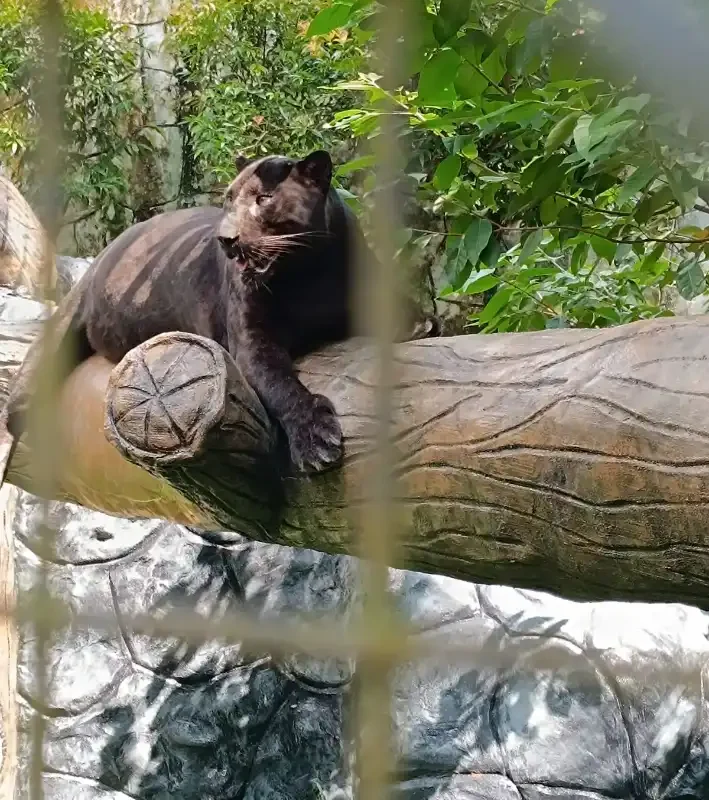
I met my first one at Zoo Negara, Malaysia’s national zoo, just outside Kuala Lumpur. It lay draped over a log, watching the crowd with pale eyes, and I had no idea at the time that it was a perfect example of one of the most unusual stories in wildlife science. All the photos in this guide are my own.
1. A black panther is not a separate species
The first thing to know is that “black panther” is not a scientific name. It is a popular label for any big cat with a black coat, usually a leopard in Asia and Africa, or a jaguar in the Americas.
Every one of these cats is a leopard (Panthera pardus), the same species you might see on safari in Kenya. The only difference is color. The dark coat is caused by melanism, an excess of the dark pigment melanin, and it comes from one small change in a single gene.
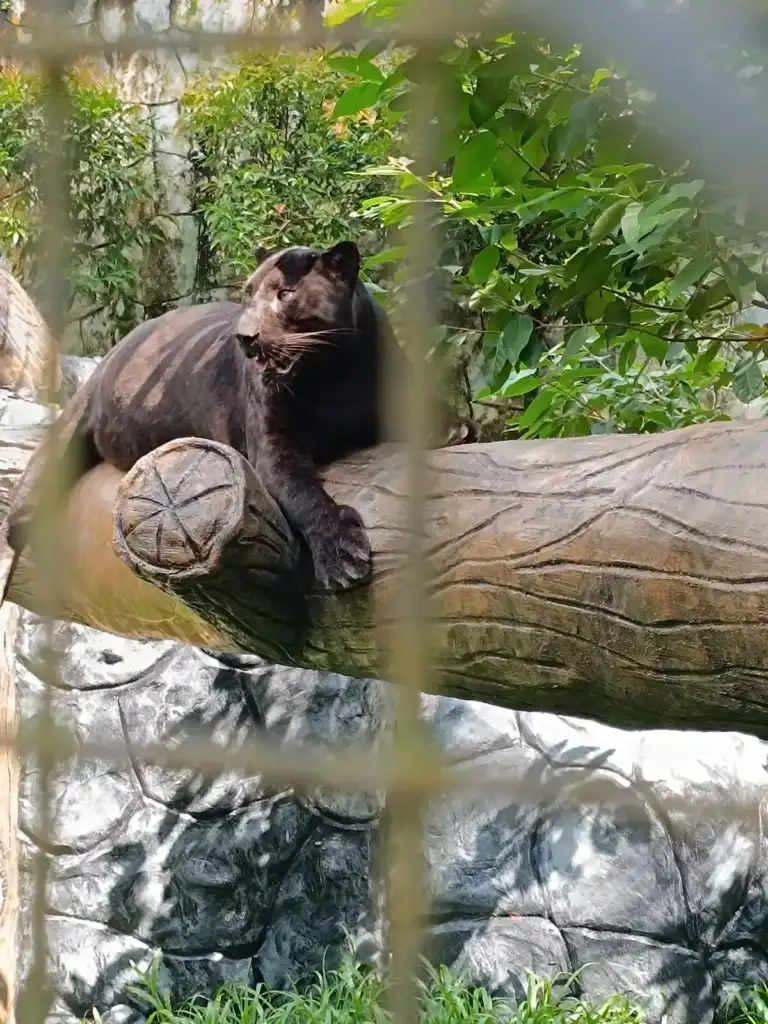
Look closely at one in good light and you will see its secret: the spots are still there. The typical leopard rosettes show through the black fur like a watermark, especially in bright sunlight. Local guides sometimes call these “ghost spots.”
2. Why almost every leopard in Malaysia is black
In most of the world, black leopards are rare. In Africa, they are so unusual that a single confirmed sighting makes international news. The Malay Peninsula is completely different.
In 2010, a team of researchers led by Kae Kawanishi published the results of a large camera-trap study across Peninsular Malaysia in the Journal of Zoology. Of the leopards photographed south of the Isthmus of Kra, virtually all were black. The researchers described this as a “near fixation” of melanism, meaning the black form has almost completely replaced the spotted form in the local population. Spotted leopards were so rare that when two were finally recorded in the peninsula years later, it was published as a scientific discovery in its own right.
The gene for black coloring in leopards is recessive, so a cub is only black if it inherits the gene from both parents. For the black form to dominate this completely, the black form must have had a clear advantage over many generations.
3. The rainforest camouflage theory
Scientists have several ideas about why the black panther Malaysia is known for won out here, and the most popular is camouflage.
The rainforests of the Malay Peninsula are among the oldest on Earth. The canopy is so thick that the forest floor stays dim even at midday. In that deep shade, a black coat may help a leopard disappear, both when stalking prey and when avoiding the Malayan tiger, a larger rival that shares the same forest.
Other theories suggest that the gene linked to melanism may also affect the immune system, helping animals resist disease in the humid tropics, or that the black form spread by chance in a small, isolated population. The honest answer is that nobody knows for sure. That is part of what makes the black panther of Malaysia so fascinating: it is a live scientific question, not a solved one.
4. Camera traps and the “invisible” cat
The coat that makes the black panther Malaysia is famous for so striking has a practical side effect: it makes the animal extremely hard to study.
Researchers usually count leopards with camera traps, then identify individuals by their unique spot patterns, much as people are identified by fingerprints. With black leopards, the spots are almost impossible to see in ordinary photos. To solve this, researchers in Malaysia modified camera traps to use infrared flash, which reveals the hidden rosettes on the black fur. With this trick, scientists were finally able to tell individual black panthers apart.
This is also why travelers almost never see one in the wild. The animals are shy, mostly nocturnal, and nearly invisible in the forest shadows.
5. Where to see the black panther Malaysia is famous for
Here is the honest truth for travelers: seeing a wild black panther in Malaysia is extremely rare. Even researchers who spend years in the forest mostly meet them through camera traps. But there are good places to try, and one place where your chances are close to guaranteed.
Zoo Negara, Kuala Lumpur. Malaysia’s national zoo is the most reliable place to see one up close. When I visited, the black leopard lay stretched along a log in its enclosure, and in the afternoon sun its ghost spots were clearly visible. The zoo is about 8 miles (13 km) from central Kuala Lumpur and easy to reach by Grab.
Taman Negara. One of the oldest rainforests in the world, and the best-known national park in Peninsular Malaysia. Black panthers live here, and night walks and hides give you a small but real chance.
Royal Belum and Endau-Rompin. These large, protected forests in the north and south of the peninsula are important strongholds for leopards and tigers. They are less visited than Taman Negara and best explored with a licensed local guide.
In the wild, go with expectations set low and curiosity set high. You are far more likely to see tracks, hear the forest at night, and learn how researchers study these cats than to see one yourself.
Malaysia’s other wild cats
The black leopard and the tiger get most of the attention, but Peninsular Malaysia is one of the richest places on Earth for wild cats. Several smaller species live in the same forests, and most travelers have never heard of them.
Clouded leopard. A medium-sized cat with huge, cloud-shaped markings and the longest canine teeth, relative to body size, of any living cat. It spends much of its life in the trees and is even harder to see than a black leopard.
Asian golden cat. A secretive forest cat whose coat ranges from golden red to gray, and which, like the leopard, also has a dark form in parts of its range.
Marbled cat. Roughly the size of a house cat, with a very long, bushy tail and a marbled coat that looks like a miniature clouded leopard.
Leopard cat. The most common wild cat in Malaysia, small and spotted, often seen at night near villages and plantations.
Flat-headed cat. One of the rarest and strangest cats in the world, with a flattened head and partly webbed feet, adapted to hunting fish and frogs along rivers and swamps.
Having this many cat species in one region is a sign of how rich and complex Malaysia’s rainforests are. It is also a reminder that protecting the forest protects far more than one famous animal.
6. Meet the neighbors: the Malayan tiger
The black leopard shares its forest with one of the rarest big cats on Earth: the Malayan tiger, a subspecies found only on the Malay Peninsula.
The Malayan tiger is critically endangered. Its wild population has fallen dramatically in recent decades because of poaching, habitat loss, and the loss of its prey. It is also a national symbol, appearing on Malaysia’s coat of arms, and its survival is one of the country’s major conservation challenges.
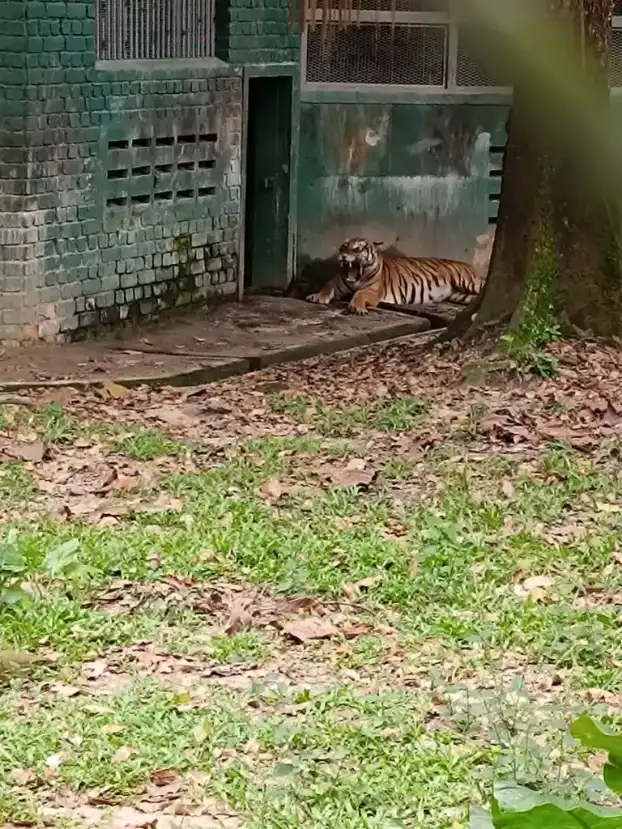
At Zoo Negara, I caught one of the tigers mid-yawn, lying in the shade by the wall of its enclosure. It was a relaxed moment, but it is also a reminder of why zoos with breeding programs matter for an animal this rare.
7. Spots vs. black: the cheetah comparison
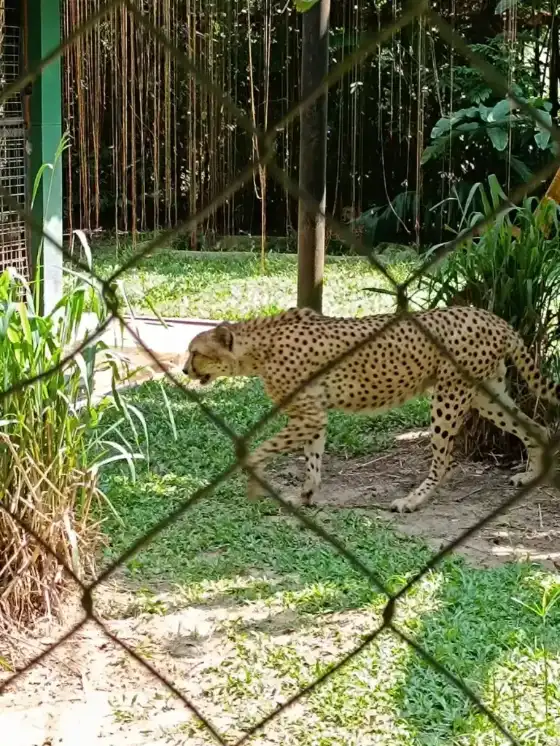
At Zoo Negara, the cheetah enclosure makes an interesting contrast. The cheetah is not native to Malaysia; it comes from the open grasslands of Africa, where a pale, spotted coat blends into dry grass and bright sunlight.
Seeing a cheetah pacing in the sun just a few minutes’ walk from a black panther resting in the shade is a neat, real-life lesson in camouflage. The spotted coat suits bright, open country. The black coat suits dark forest. Both are the result of the same basic principle: over time, the coat that hides you best is the one that survives.
8. More wildlife at Zoo Negara
If you visit Zoo Negara to see the black leopard, give yourself time for the rest of the park. It is set in green, forested grounds, and some of its best moments happen outside the enclosures.
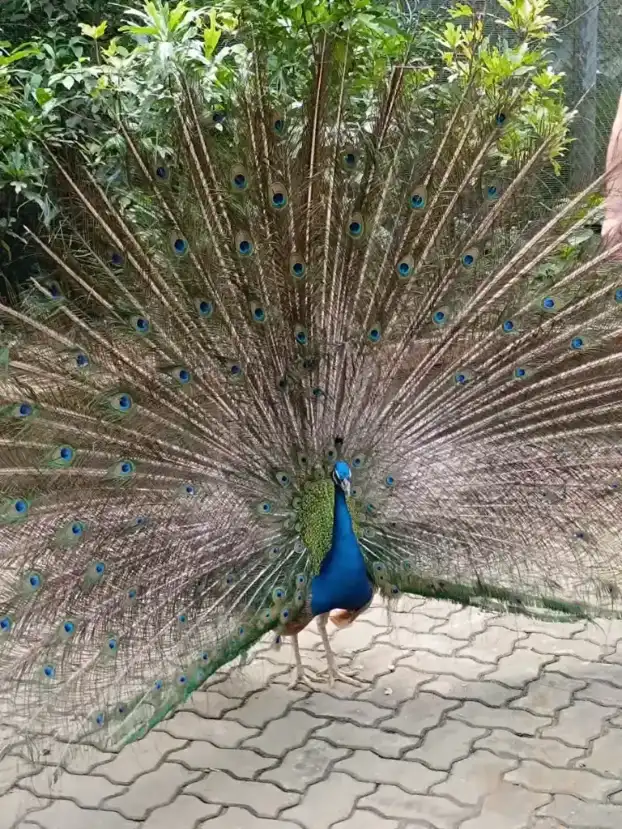
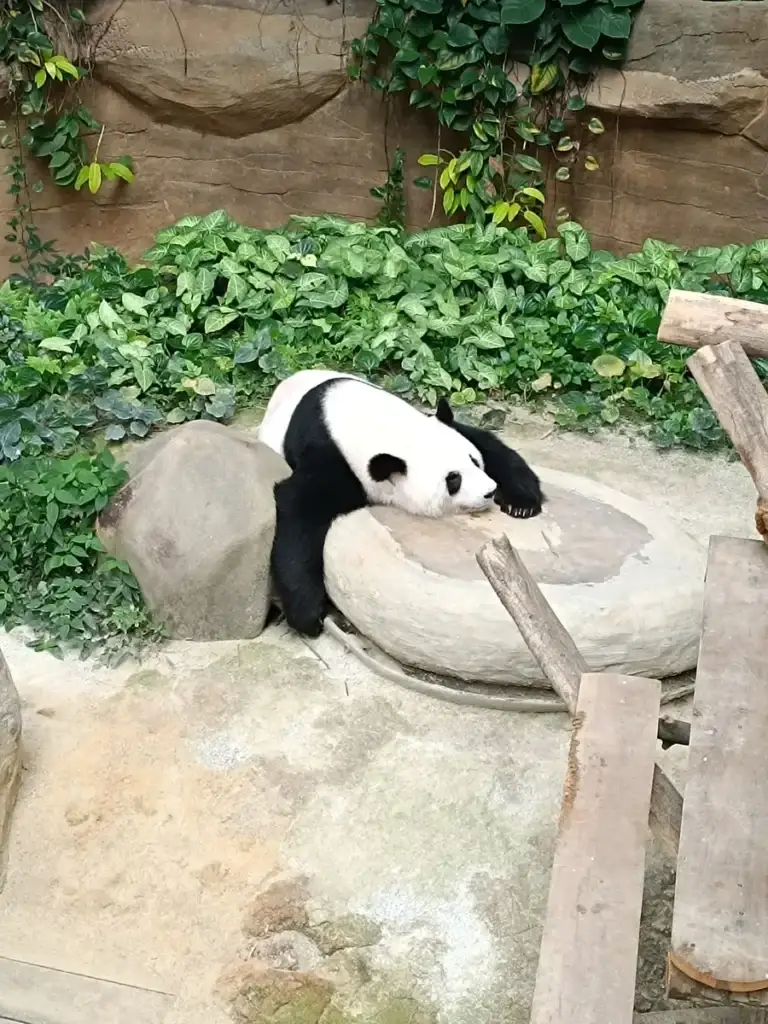
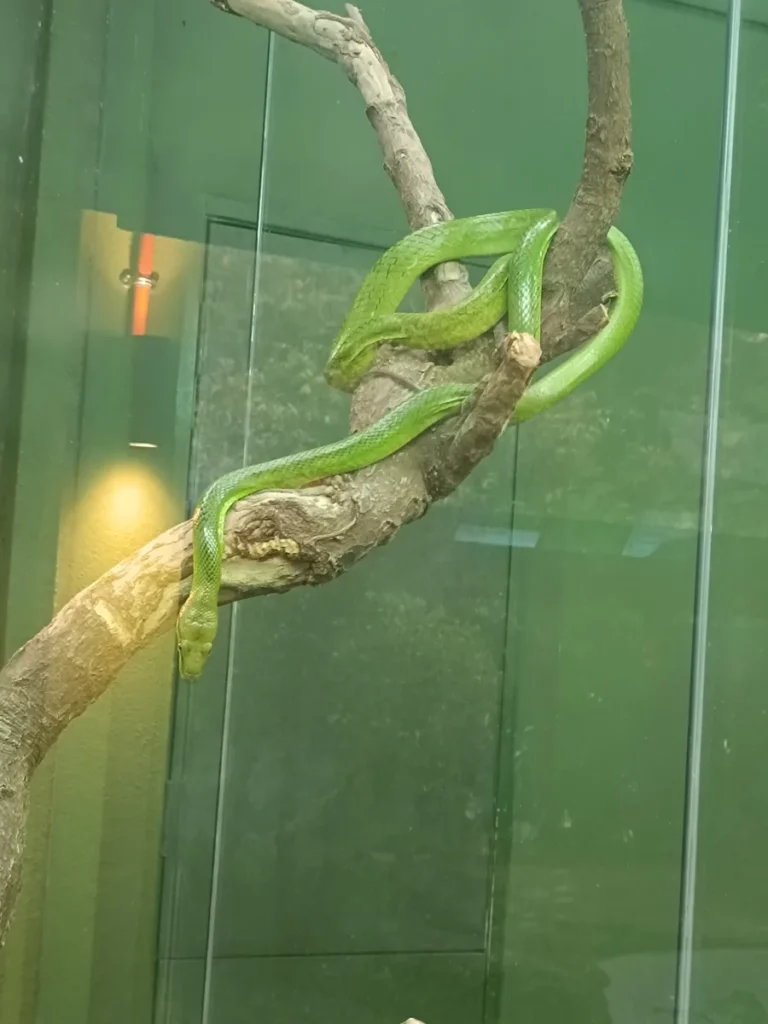
Indian peafowl walk freely along the paths, and a male peacock may open his full tail just a few feet from you. The zoo’s Giant Panda Conservation Centre, run in partnership with China, is a highlight for many visitors, and the reptile house holds animals such as the bright green pit viper, a native Malaysian snake that is almost invisible among leaves.
Go early in the morning. The animals are much more active before the midday heat, and the big cats, the black leopard included, often spend the afternoon asleep.
9. How travelers can help Malaysia’s big cats
The future of the black panther Malaysia calls its own depends on its forest. Leopards and tigers need large, connected areas of rainforest, and those areas are under pressure from logging, plantations, and roads.
Travelers can help in simple ways. Choose licensed local guides and eco-lodges in national parks, as they depend on healthy forests and help protect them. Never buy wildlife products, including skins, claws, or “traditional medicine” made from animal parts. And support organizations that work on big-cat conservation in Malaysia, such as the Malaysian Conservation Alliance for Tigers (MYCAT) or WWF-Malaysia.
Even a zoo ticket helps: Zoo Negara is run by a non-governmental society, and part of the admission price supports its conservation and breeding work.
Practical tips for visiting Zoo Negara
If Zoo Negara is where you plan to see your first black leopard, a little preparation makes the visit much more enjoyable.
Getting there. The zoo is in Ulu Klang, about 8 miles (13 km) northeast of central Kuala Lumpur. A ride-hailing app such as Grab is the easiest option, usually 25 to 40 minutes each way. Avoid the evening rush hour for the ride back.
Timing. Arrive when the gates open. The big cats are most active in the cooler morning hours, and by mid-afternoon most of them are asleep in the shade.
How long to stay. Plan three to five hours. The park covers roughly 110 acres (45 hectares), and a tram runs around it for an extra fee if you want to save your legs.
Tickets. Malaysia uses separate prices for citizens and international visitors. Foreign adult tickets are modest by US standards, and the panda center may charge a small extra fee. Check the official website for current prices and opening hours.
What to bring. Water, sunscreen, a hat, and insect repellent. Kuala Lumpur is hot and humid year-round, and short afternoon showers are common, so a compact umbrella is useful too.
Photos through the fence. Many enclosures have wire mesh. To make it disappear in photos, put your phone lens right up against a gap in the mesh and focus on the animal behind it. That is how I took the photos of the leopard and the cheetah in this guide.
Frequently asked questions
Are there black panthers in Malaysia?
Yes. The black panther in Malaysia is a black (melanistic) leopard. On the Malay Peninsula, south of the Isthmus of Kra, nearly all wild leopards are black, which makes the region one of the only places in the world where the black form is the norm rather than a rare exception.
Why are leopards in Malaysia black?
The black coat comes from a recessive gene that causes melanism. A 2010 camera-trap study found the black form in almost all leopards on the Malay Peninsula. The leading theory is that a dark coat gives better camouflage in the dim, dense rainforest, but scientists have not proven the exact reason.
Is a black panther a different species from a leopard?
No. A black panther is not a separate species. In Asia and Africa, it is a leopard (Panthera pardus) with black fur. In the Americas, the name usually refers to a black jaguar. The spots are still present and can be seen in bright light.
Where can I see a black panther in Malaysia?
The most reliable place is Zoo Negara, Malaysia’s national zoo near Kuala Lumpur. In the wild, black panthers live in forests such as Taman Negara, Royal Belum, and Endau-Rompin, but they are shy, nocturnal, and very rarely seen.
Is the black panther dangerous to tourists?
Attacks on people are extremely rare. Black leopards in Malaysia avoid humans and are mostly active at night deep in the forest. Travelers on guided walks in national parks are very unlikely to encounter one.
The rainforest’s black secret
The black panther in Malaysia is not a legend or a genetic accident. It is the result of a single gene that has quietly taken over an entire population, leaving the Malay Peninsula with something no other place in the world quite has: a forest where the leopards are almost all black. Whether you meet one resting on a log at Zoo Negara or only hear the forest at night in Taman Negara, knowing this story changes what you see. Look for the ghost spots. They are the leopard hiding in plain sight.
Love wildlife travel? Read how to see sea turtles in Sri Lanka the responsible way. The science behind the black panther of Malaysia comes from Kawanishi et al. (2010), Journal of Zoology.