When travelers ask, “What do people eat in Micronesia?” they expect one answer. There isn’t one. The Federated States of Micronesia is four separate states, Pohnpei, Chuuk, Yap, and Kosrae, spread across 2,700 kilometers of ocean, and each has its own staple crop, its own prestige food, and its own way of cooking it.
What unites them is a base of taro, breadfruit and yam, and reef fish, all cooked with coconut. What divides them is which of those matters most, and what a family serves when it wants to make a statement.
What do people eat in Micronesia? The three pillars
1. Root crops: taro, yam, and breadfruit
Root crops are the calorie base across all four states, but the hierarchy shifts island to island.
- Taro (sawa in Pohnpeian), grown in wet patches, boiled, pounded, or baked
- Yam (kehp), the prestige crop of Pohnpei, grown to enormous size
- Breadfruit (mai), seasonal, roasted, fermented, or pounded
- Cassava, introduced later, now everywhere because it grows easily
- Sweet potato, common, often the everyday filler
Breadfruit deserves its own note. When it’s in season it arrives in overwhelming quantity, which is why every Micronesian culture developed a way to ferment and pit-store it. That preserved paste kept communities alive through typhoons and lean months for centuries.
2. Reef fish and seafood
The ocean provides most protein, and the catch varies with the reef:
- Tuna, wahoo, and mahi-mahi from deeper water
- Parrotfish, snapper, and grouper from the reef
- Octopus, sea cucumber, and clams from the shallows
- Mangrove crab and coconut crab, the delicacy
- Turtle, traditionally, though now restricted
Fishing is still largely a household activity rather than an industry. In Chuuk especially, a man’s fishing skill remains a real measure of standing.
3. Coconut
Coconut is the cooking medium, the sweetener, the drink, and the packaging. Grated flesh pressed into thick cream forms the base of nearly every traditional dish. Husks fuel cooking fires. Leaves wrap food for the earth oven.
Understanding what people eat in Micronesia starts with understanding that coconut is not a flavor here. It’s infrastructure.
What people eat in Micronesia varies by island: the four states eat differently: here’s how
| State | Defining food | What makes it distinct |
|---|---|---|
| Pohnpei | Giant yams, sakau | Over 100 words for yam varieties; yams grown for prestige, not just food |
| Kosrae | Fahfah | Pounded soft taro with banana and coconut; the state’s signature dish |
| Yap | Taro and fish soup | Simplest preparations; stone ovens and direct grilling still standard |
| Chuuk | Seafood, breadfruit | Strongest fishing culture; fried fish and fish soups dominate |
Pohnpei: the island where yams are a competition
Pohnpei has over one hundred words for different yam varieties, sizes, and growing conditions. This is not linguistic trivia. It reflects how central the crop is to social life.
Yams here are grown for size and status rather than for eating, and the scale is genuinely hard to believe. Competitive yams can exceed four meters in length and weigh more than 200 kilograms. A single yam may spend up to ten years in the ground before it’s lifted.
Men cultivate them in secret, remote plots, one grower might tend around fifty yams at a time, and the location of a prize specimen is kept quiet until harvest. Growing technique is guarded family knowledge.
Lifting one is an event in itself. The yam is carried on a special litter called a pahs, which takes several men, and presented formally to the Nahnmwarki, the paramount chief. At the ceremonial feast, the man who brings the largest yam is declared “Number One” and publicly praised by the chief for his generosity.
This matters more than a competition. Historically, presenting the biggest yam was one of the few available routes to advancement within Pohnpei’s title system. Pohnpeians describe yams as “young man’s vines” and “the result of a man’s work”. The size of the yam is a visible measure of years of labour, and everyone at the feast can read it instantly.
Pohnpei is also the spiciest of the four states, with local pepper varieties used in ways the other islands don’t.
Kosrae: fahfah, the dish that defines a state
Fahfah is Kosrae’s signature: soft taro pounded until smooth, combined with ripe banana, and served with coconut cream. Some versions add fish. The texture is thick and sticky, closer to a dough than a purée.
Kosraean coconut soup is the other standout. Fish, breadfruit, banana, and sometimes chicken simmered together in coconut milk. It’s a one-pot meal that reflects how Kosraeans actually eat rather than how they entertain.
Yap: simplicity as a principle
Yap prepares food with less intervention than the other states. Taro, yam, and breadfruit are cooked plainly to keep their own flavor. Fish is grilled directly over coals or cooked in stone ovens.
Yapese taro fritters, grated taro fried with coconut milk and a little sweetness, are the exception, and they appear mostly at celebrations.
Yap is also the state where traditional practice persists most visibly overall, and food follows that pattern.
Chuuk: seafood above everything
Chuuk‘s lagoon is one of the largest in the world, and the food culture reflects it. Fried fish, fish soups, and dishes built around breadfruit and taro make up the everyday table. Preparation is straightforward; the quality of the catch does the work.
Sakau: the drink that structures social life
Sakau, a kava relative documented by the Smithsonian among Pacific ceremonial plants, shapes as much of what people eat in Micronesia as any single dish.
No account of what people eat in Micronesia is complete without sakau (kava), and Pohnpei is its center.
The root of the pepper plant Piper methysticum is pounded on a flat basalt stone, mixed with water, and strained through hibiscus bark. The result is a muddy, earthy drink that numbs the mouth and produces a calm, heavy relaxation.
Sakau is not casual. It’s drunk in a specific order determined by rank, at markets, at ceremonies, and at reconciliations. The pounding itself, a rhythmic knocking heard across Pohnpei in the evenings, is part of the ritual.
Kosrae, by contrast, is largely dry and Christian-influenced, with alcohol and kava both discouraged. Four states, four different relationships to what’s in the cup.
How is food cooked in Micronesia?
**The earth oven (uhmw).** Hot stones in a pit, food wrapped in banana or breadfruit leaves, covered and left for hours. Used for feasts and Sundays rather than daily meals. Produces the smoky, tender result that no pot reproduces.
Coconut cream stewing. Grated coconut is pressed by hand into cream and used as the cooking liquid. This is the default method for taro leaves, fish, and root crops.
Pounding. Taro and breadfruit are pounded with a stone or wooden pestle into a smooth mass. Fahfah, and the various pounded breadfruit dishes, depend on it.
Fermentation pits. Breadfruit is buried in leaf-lined pits and left to ferment for months or years. Sour and pungent, it was the insurance policy that made atoll life survivable.
What do people eat in Micronesia daily?
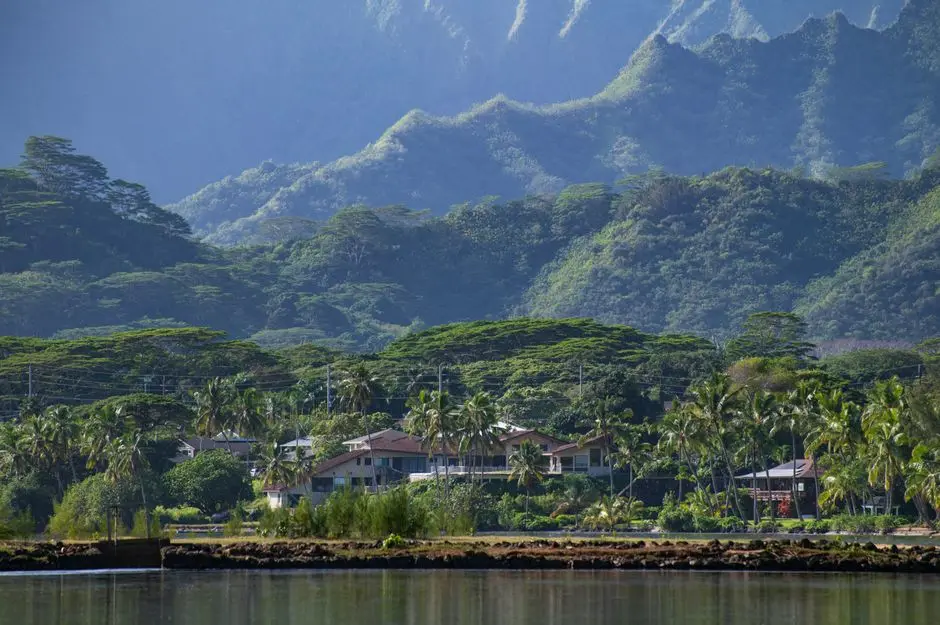
In town: Kolonia, Weno, Colonia, Tofol
- Imported white rice at most meals, replacing taro and breadfruit
- Canned meat, particularly spam and corned beef, as normal food
- Instant noodles and imported snacks widely eaten
- Small stores stocked mainly with shelf-stable imports
- Restaurants serving a mix of American, Japanese, and Filipino food
In the outer islands
- Breakfast: leftover taro or breadfruit, tea or coconut water
- Lunch: grilled fish with a root crop
- Dinner: coconut soup, fish, whatever the day produced
- Almost no imported food; subsistence fishing and gardening still dominant
The gap between these two lists is the single biggest change in what people eat in Micronesia over the past fifty years.
The health cost of the shift
Micronesia has among the highest rates of diabetes and obesity in the world. In some communities more than a third of adults over 25 have type 2 diabetes.
The traditional diet is not the cause. Fish, taro, breadfruit, and coconut are nutritionally sound. The cause is the replacement of that diet with imported white rice, sugar, canned meat, and soft drinks. Cheap, shelf-stable, and available where fresh food is not.
The orange banana that came back
Pohnpei has one of the best-documented food stories in the Pacific, and almost nobody outside nutrition circles knows it.
In 1997 an American nutritionist named Lois Englberger moved to Pohnpei and noticed something worrying: children were showing signs of vitamin A deficiency. A condition that causes blindness and raises child mortality, and which had not historically been a problem on the island. The cause was the shift to imported, nutrient-poor food.
Rather than reach for supplements, Englberger went looking for what islanders used to eat. She kept hearing about karat. A squat, deep-orange-fleshed banana that older Pohnpeians remembered being fed to babies as a first food, and which had fallen out of cultivation in favour of imported varieties.
Testing showed why it had worked. Karat contains more than 25 times the beta-carotene of the common Cavendish banana most of the world eats. The body converts beta-carotene into vitamin A. Pohnpei had been growing the solution to its own deficiency problem all along, and had stopped.
A campaign to promote karat began in 1999 and grew into the broader “Go Local” movement run by the Island Food Community of Pohnpei. Cultivation revived, and karat went from hard to find to routinely available in local markets.
There’s a wider point here that applies across the Pacific. Before Englberger presented her findings internationally in 2004, most nutrition scientists outside the region didn’t know orange-fleshed bananas existed at all, let alone that they could address a deficiency disease. The traditional food wasn’t primitive or nutritionally inferior to what replaced it. It was better. And it took a researcher asking elders what they used to feed babies to establish that.
If you’re in Pohnpei, ask for karat. It’s the most nutritionally remarkable thing you can eat in Micronesia, and it exists commercially because someone went looking for it.
How travelers can experience what people eat in Micronesia
Markets over restaurants
Restaurants in the state capitals serve mostly imported cuisine. Markets are where the actual food is, taro, breadfruit, reef fish, bananas, and locally made snacks.
Pohnpei’s Kolonia market and Chuuk’s Weno market are the most accessible starting points.
Sunday and feast food
Traditional cooking happens at church gatherings, funerals, and community feasts rather than commercially. Earth-oven food, pounded taro, and ceremonial yams are served there and essentially nowhere else.
Sakau bars in Pohnpei
Sakau is served at open-air bars across Pohnpei, and visitors are generally welcome. Go with someone local the first time. The etiquette around who drinks in what order is real, and getting it wrong is noticed.
Etiquette worth knowing
- Accept what’s offered, even a small portion
- Don’t refuse the first cup of sakau if it’s handed to you
- Ask before photographing food at ceremonies, some occasions are private
- Bring something when invited to a household meal
- Compliment the cook; effort is noticed
Frequently asked questions: what do people eat in Micronesia?
What is the national dish of Micronesia?
There is no single national dish, because the four states have distinct cuisines. Fahfah is Kosrae’s signature, giant yams define Pohnpei, and coconut crab is prized across all of them.
What is sakau?
Sakau is Micronesian kava. A drink made from the pounded root of Piper methysticum, mixed with water and strained. It’s central to Pohnpeian social and ceremonial life and produces relaxation rather than intoxication.
Why are Pohnpeian yams so large?
They’re grown competitively for ceremonial presentation, where size demonstrates the grower’s status. Competitive yams can exceed four meters and weigh over 200 kilograms, and a single yam may take up to ten years to grow. They’re carried on a purpose-built litter called a pahs and presented to the Nahnmwarki, the paramount chief.
What is a karat banana?
A short, deep-orange-fleshed banana native to Pohnpei, traditionally fed to infants. It contains over 25 times the beta-carotene of a common Cavendish banana, and was revived from near-abandonment in the late 1990s to address vitamin A deficiency in children.
Is Micronesia the same as the Federated States of Micronesia?
No. Micronesia is a wider region that includes Palau, the Marshall Islands, Kiribati, Guam and others. The FSM is one country within it, made up of Yap, Chuuk, Pohnpei and Kosrae.
Do people in Micronesia eat rice or taro?
Both. Imported rice is now the everyday staple in towns, while taro, breadfruit, and yam remain the traditional staples served at ceremonies and still dominant in outer islands.
Is coconut crab eaten in Micronesia?
Yes. Coconut crab is a delicacy across the region, usually grilled or boiled and served simply. Populations are declining, and harvesting is increasingly regulated.
Is Micronesian food spicy?
Mostly mild, with one exception. Pohnpei uses local pepper varieties and produces noticeably spicier dishes than the other three states.
Is tap water safe to drink in Micronesia?
Generally no. Bottled, boiled, or filtered water is advisable in all four states, and rainwater catchment is the norm in outer islands.
Conclusion: what do people eat in Micronesia? Four answers, not one
To ask what people eat in Micronesia is to get four different answers depending on which island you’re standing on. Pohnpei will show you a yam that takes four men to lift. Kosrae will hand you fahfah. Yap will grill you a fish over coals with nothing added. Chuuk will take you out on the lagoon first.
What they share is a food culture built for isolation. Fermentation pits, earth ovens, and a coconut palm that supplies everything from cooking fat to fuel. And what they now share is the cost of abandoning it: rice, spam, and one of the highest diabetes rates on earth.
For a comparison with an atoll nation where the same shift is happening under different pressure, see our guide to what people eat in Kiribati, or explore more Oceania travel guides.