When travelers ask what Buddhist temples in Sri Lanka are actually like, the short answer is that they are not single buildings. A Sri Lankan temple is a walled compound with three separate objects of worship inside it, and you are expected to visit all three, barefoot, in a particular order.
Around 70% of Sri Lankans are Buddhist, and the temple — the vihara — is still the working centre of village life rather than a monument. Most visitor mistakes come from treating the compound like a museum with one main exhibit, or from arriving in the wrong clothes and being turned away at the gate.
Almost every visitor to Sri Lanka ends up inside a temple, and a surprising number get turned away at the door first. The rules aren’t complicated, but they’re enforced properly rather than politely, and a pair of shorts or a shoulder-baring top is enough to end the visit before it starts. This is what to know before you go.
Accurate as of August 2026. Entrance fees in Sri Lanka change frequently and vary between sources. Treat the figures below as a guide and confirm on arrival. Bring cash in Sri Lankan rupees.
What is inside Buddhist temples in Sri Lanka — the three places of worship
Sri Lankan temple architecture divides into ritual, ecclesiastical and residential buildings, representing the Buddha, the doctrine and the monastic order. As a visitor you interact only with the first group, and it contains three specific structures.
1. The dagoba (stupa)
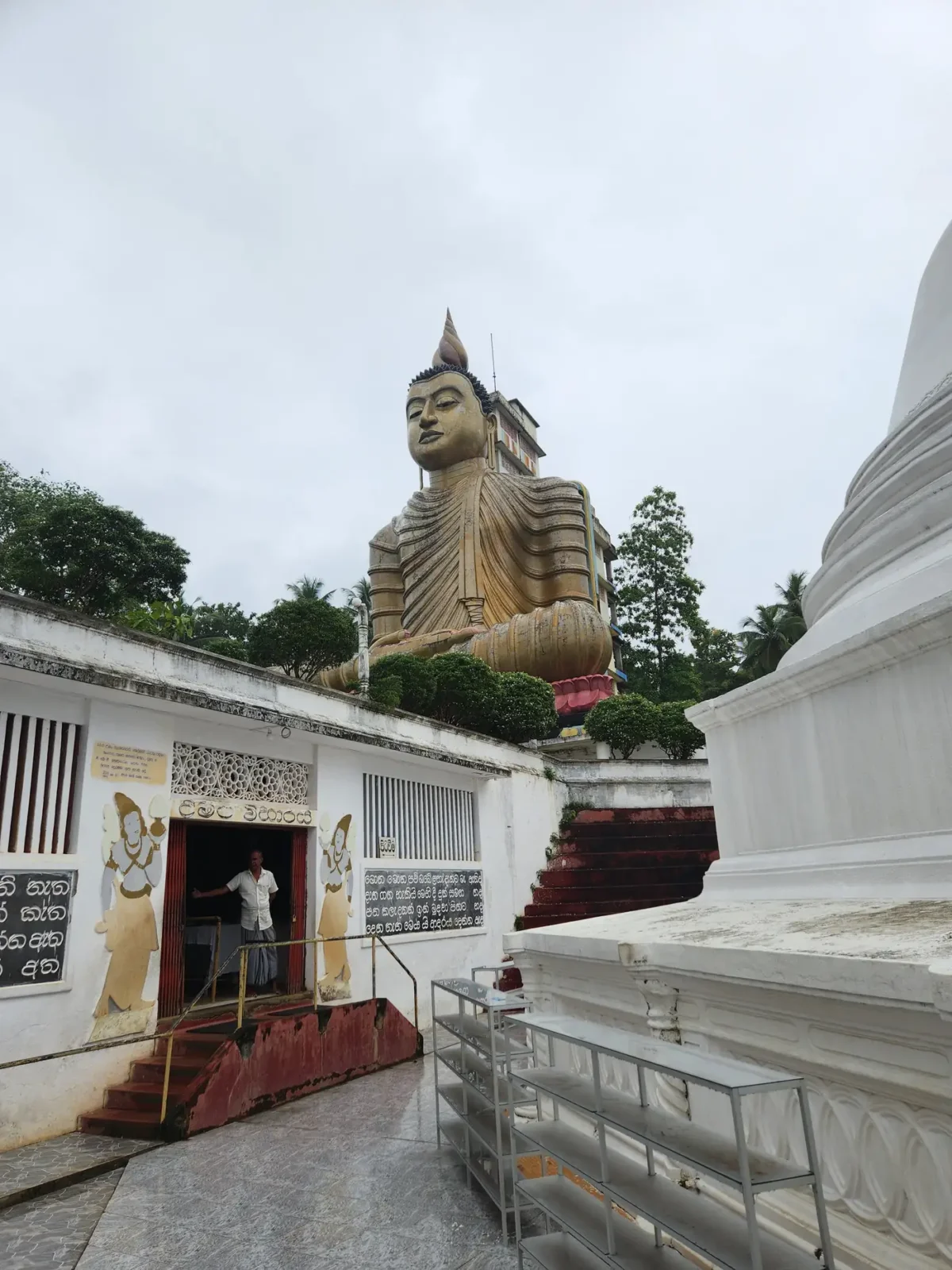
The dagoba is the white dome visible from outside the wall. It is solid and sealed — there is no entrance and nothing to go inside. Dagobas enshrine bodily relics, which is why they are treated as the most sacred object in the compound despite being the least visually dramatic. You walk around it clockwise, keeping it on your right. Never anticlockwise.
2. The bodhi tree
The bodhi is a sacred fig grown from the lineage of the tree the Buddha sat under at his enlightenment. It usually stands on a raised, railed platform, wrapped in strips of coloured cloth and ringed with small oil lamps. The bodhi shrine — the bodhighara — is where people spend the longest, pouring water at the roots and lighting lamps.
3. The image house
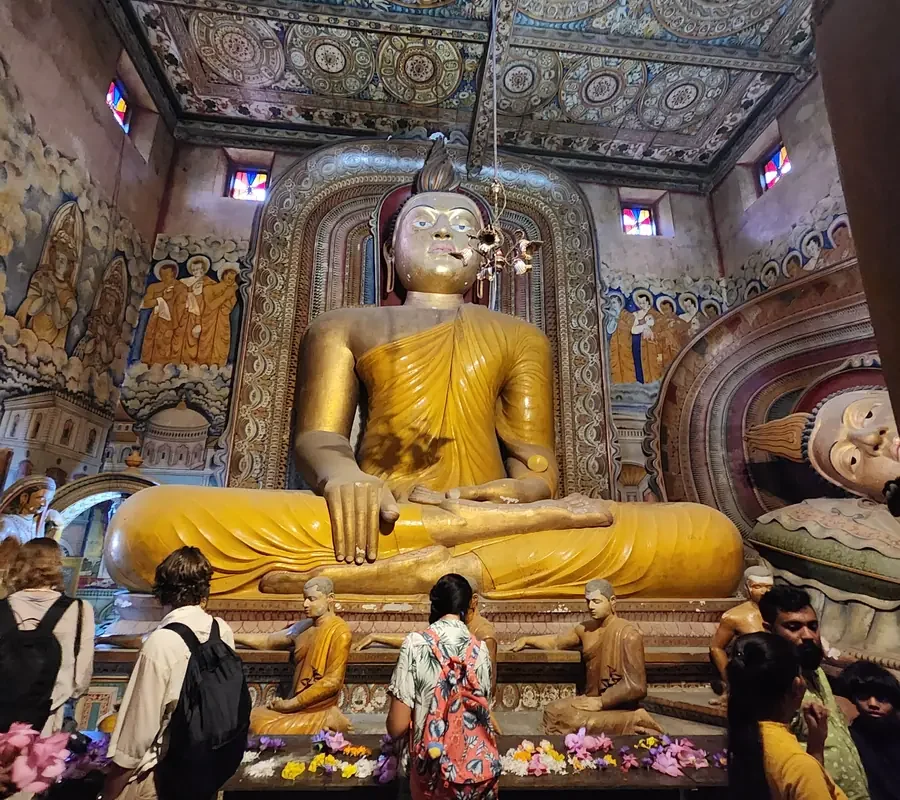
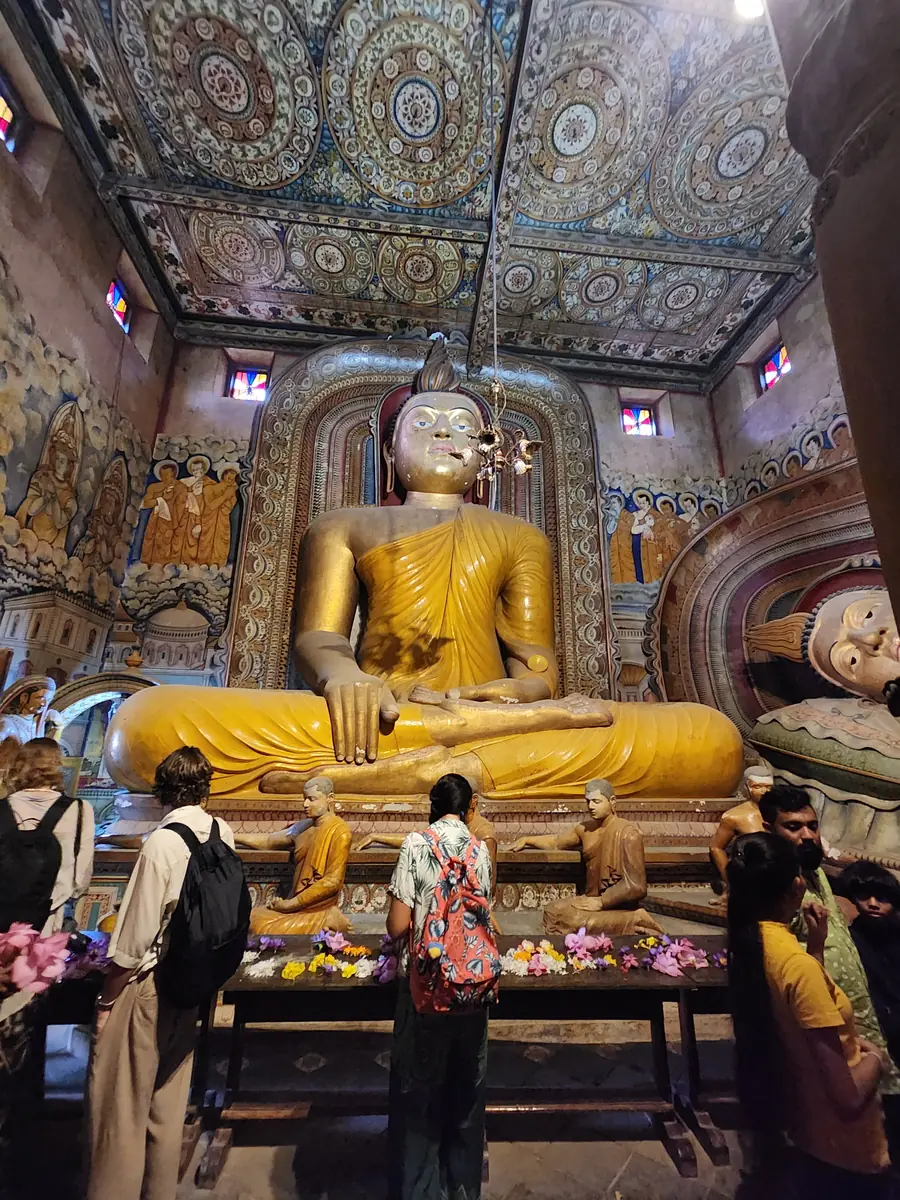
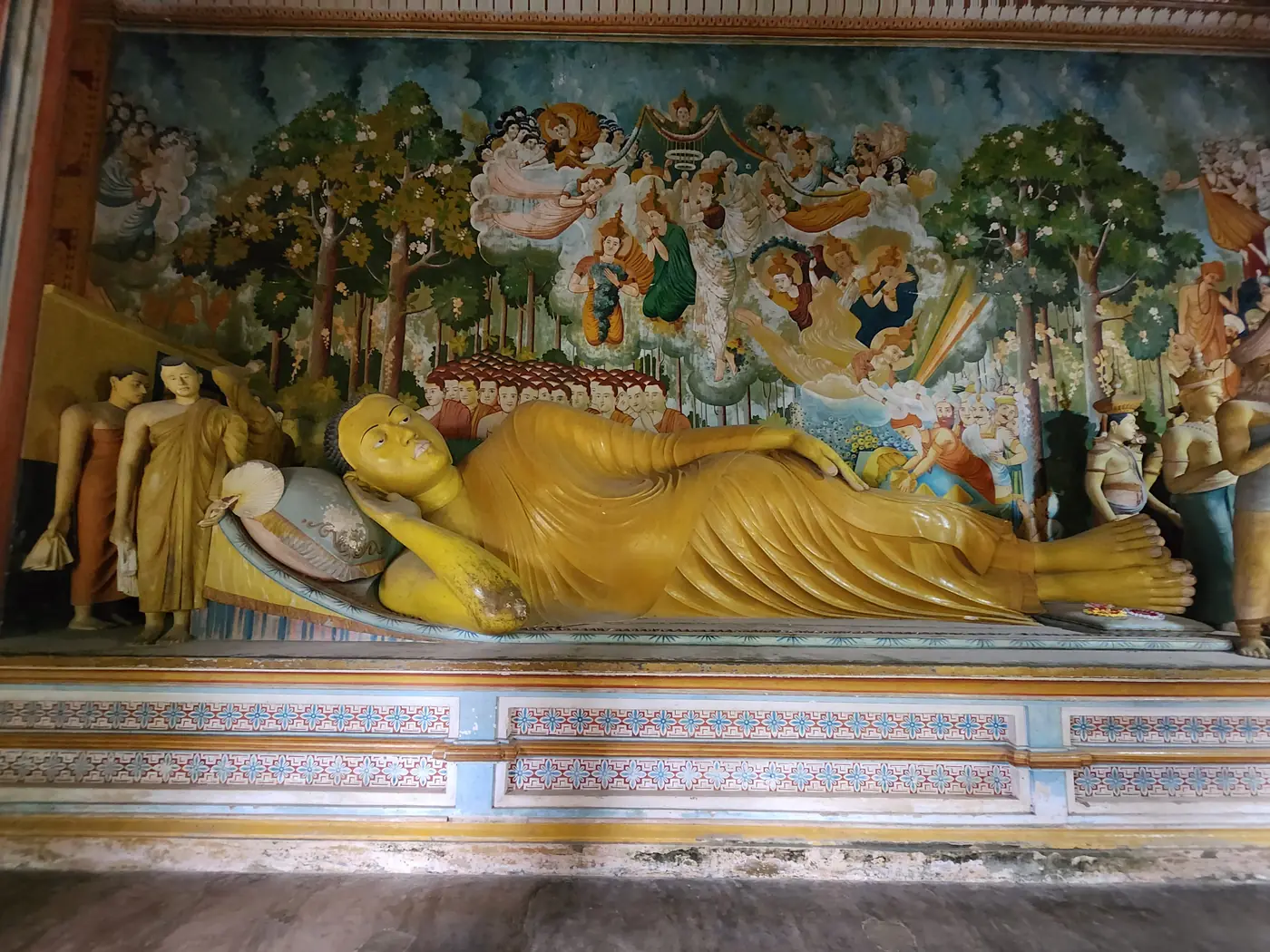
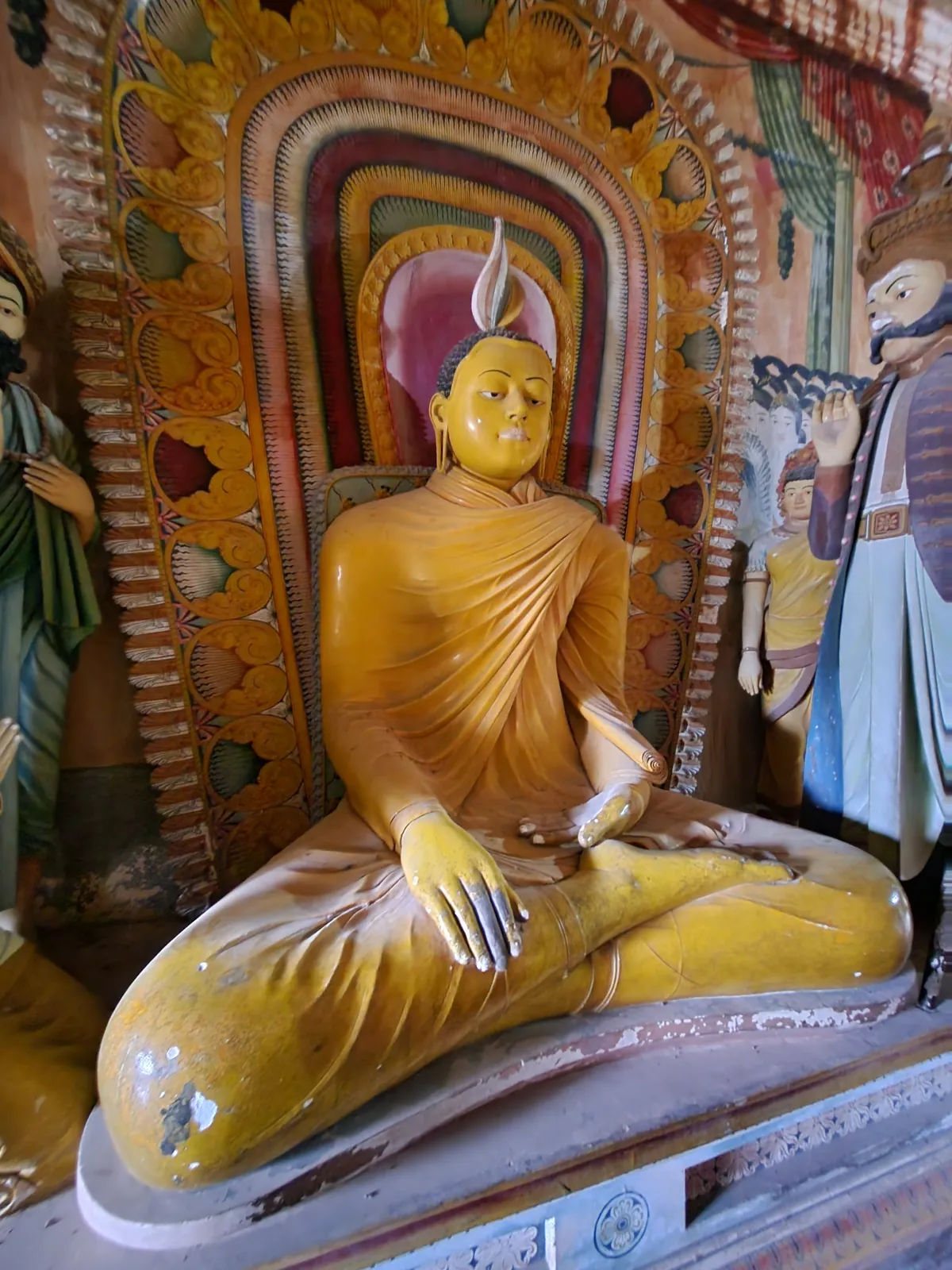
The image house, or vihara geya, is the enclosed building holding the Buddha statues. This is the part most travelers photograph and the part where rules are strictest: shoes off before the steps, hat off, shoulders and knees covered, and never turn your back on the statue.
Temple vocabulary worth knowing
| Feature | Sinhala term | What it is | Can you enter? |
|---|---|---|---|
| Dagoba / stupa | dagoba | Solid white dome enshrining relics | No — walk around it clockwise |
| Bodhi tree shrine | bodhighara | Sacred fig on a raised platform | Platform yes, barefoot |
| Image house | vihara geya | Building holding the Buddha statues | Yes — shoes and hat off |
| Deity shrine | devale | Separate shrine to a Hindu-origin deity | Usually yes |
| Monks’ quarters | pansala | Where the resident monks live | No, unless invited |
| Entrance arch | makara torana | Ornate gateway with mythical guardians | It is the way in |
| Preaching hall | dharma shalawa | Open hall used for sermons and chanting | Yes, if not in use |
| Year-round lamp | dolosmahe pahana | Oil lamp kept burning all year | Look, don’t touch |
The makara torana — the creature in the gateway
The arch you pass under to enter is often a makara torana, and it rewards a proper look rather than walking straight through. The makara is a composite mythical animal: elephant’s trunk, lion’s paws, boar’s ears, the body of a fish. The arch rises from the open jaws of one makara, peaks in a face-of-glory motif, and descends into the jaws of a second. Its job is guardianship — keeping malevolent spirits out of the compound — and it doubles as a prosperity symbol shared with Hindu iconography.
Once you know what to look for, makara appear everywhere in Sri Lanka: framing Buddha statues, on temple doorframes, carved into stone balustrades.
The dress code, in plain terms
This applies at every Buddhist temple on the island, not just the famous ones.
- Shoulders covered. No vests, no sleeveless tops, for men and women alike.
- Knees covered. No shorts, no short skirts. Long trousers or a sarong.
- Shoes off. Removed before entering the sacred area, not just the building. There is usually a minder charging a small fee to watch them.
- Hats off. Remove them as you enter.
- White is appreciated but not required. Locals often wear white to temple.
Two practical notes. Sarongs are available to rent or buy at the entrance of major temples if you turn up unprepared, which is common and not embarrassing. And the ground gets extremely hot, particularly at Dambulla where you cross open stone at midday, so socks are a genuinely useful thing to carry.
What people bring — offerings explained
Nobody arrives at a temple empty-handed, and the offerings are consistent enough that you can predict them.
- Flowers. Usually lotus, or araliya (frangipani), bought at a stall outside the gate for a few hundred rupees and arranged on a tray. Here is the detail most guides skip: you lay a tray at each of the three places of worship, not one for the whole visit. If you see someone buy a single tray and split it into three at the gate, that is why.
- Oil lamps. Small clay lamps lit with coconut oil, representing wisdom dispelling ignorance.
- Incense. For purity.
- Alms food. Given to the resident monks rather than placed at the statues, and usually in the morning.
Why everyone is wearing white
On significant days laypeople wear white, a sign of purity, and loose enough that it covers shoulders and knees automatically. You are not expected to wear white as a visitor, but you are expected to match the modesty standard it implies.
Photography rules at Buddhist temples in Sri Lanka
Photography is usually allowed, with two consistent exceptions that are taken seriously.
Never turn your back on a Buddha statue for a photograph. Posing with your back to the image, which is the natural instinct for a selfie, is considered disrespectful. Stand beside it and face the camera at an angle instead.
Buddha tattoos and images on clothing are a legal problem, not just an etiquette one. Sri Lanka has refused entry to and deported travellers over visible Buddha tattoos. If you have one, keep it covered.
Flash is usually prohibited inside shrine rooms because it damages old murals, and some inner chambers ban photography entirely. Signs are clear where this applies.
Poya — the full moon day that closes the country
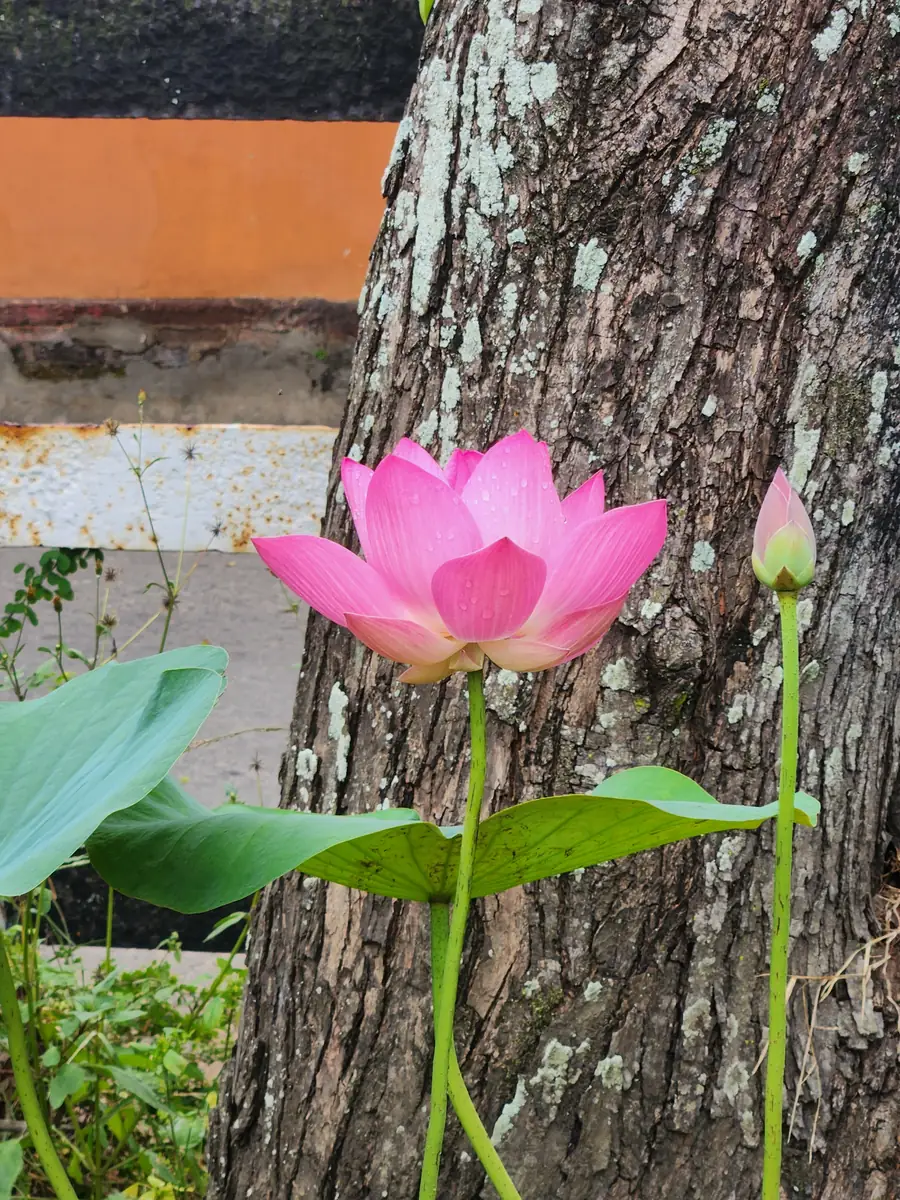
Every full moon is a poya day and a public holiday in Sri Lanka — not a symbolic one. Alcohol sales stop island-wide, many businesses close, and temples fill up. This matters for planning in two opposite ways.
- If you want to see a temple as a living religious space rather than a tourist site, go on poya. The chanting, the lamps, the crowds in white — this is the version that explains the place.
- If your plan for that day involved a drink with dinner, it will not happen. Bars and liquor shops close and many hotels stop serving.
Poya dates shift each year with the lunar calendar, so check before booking. Esala Poya, usually in July or August, coincides with the largest Buddhist festival on the island — see our guide to Esala Perahera in Kandy.
Temple of the Sacred Tooth Relic, Kandy
The most important Buddhist site in the country, and the reason Kandy exists as a religious centre. It houses the Sacred Tooth Relic of the Buddha, an object so tied to political legitimacy that for centuries whoever held it was considered the rightful ruler of the island.
What you should know:
- You will not see the relic. It sits inside a series of nested caskets in an inner chamber. What visitors see is the chamber and the golden casket, during ritual hours.
- Time your visit to a pooja. Ritual ceremonies happen three times daily, roughly early morning, mid-morning and evening, when the inner chamber doors open and drummers play. Outside these windows the doors are shut and the experience is much quieter.
- Foreign visitor entry runs around LKR 2,000–2,500, subject to change.
- Security is thorough. Bag checks and a walk-through are standard, a consequence of the site’s history.
- It gets very busy during Esala Perahera in July or August.
Dambulla Cave Temple
A UNESCO World Heritage Site and, for many visitors, the more visually striking of the two. Five caves cut into a rock face hold over 150 Buddha statues and painted ceilings that follow the natural curve of the rock, some dating back over two thousand years.
- There’s a climb. Roughly 350 steps to reach the caves. Not technical, but hot, and there is no shade for much of it.
- Entry is around LKR 1,500–3,000 for foreign visitors depending on the source and recent changes. Bring cash.
- Open roughly 7 AM to 7 PM, with the ticket office closing considerably earlier, around 5 PM.
- Go early or late. Midday means both the worst heat and the hottest stone underfoot on bare feet.
- Watch for monkeys. They are numerous, bold, and will take food or loose items.
- Buy your ticket at the correct booth. The ticket office and the cave entrance are not in the same place, and people regularly climb the steps before realising.
Other temples worth your time
| Temple | Where | Why go |
|---|---|---|
| Gangaramaya | Colombo | Eclectic and busy, easy to reach; hosts Navam Perahera in February |
| Kelaniya Raja Maha Vihara | Near Colombo | Outstanding murals, far fewer tourists |
| Mihintale | Near Anuradhapura | Where Buddhism arrived in Sri Lanka; a stair climb with wide views |
| Isurumuniya | Anuradhapura | Rock temple famous for its carved stone figures |
| Aluvihare | Near Matale | Where the Buddhist canon was first written down on palm leaves |
| Seema Malaka | Colombo | Small platform temple on Beira Lake; quiet, photogenic |
The Buddhist temples in Sri Lanka nobody writes about
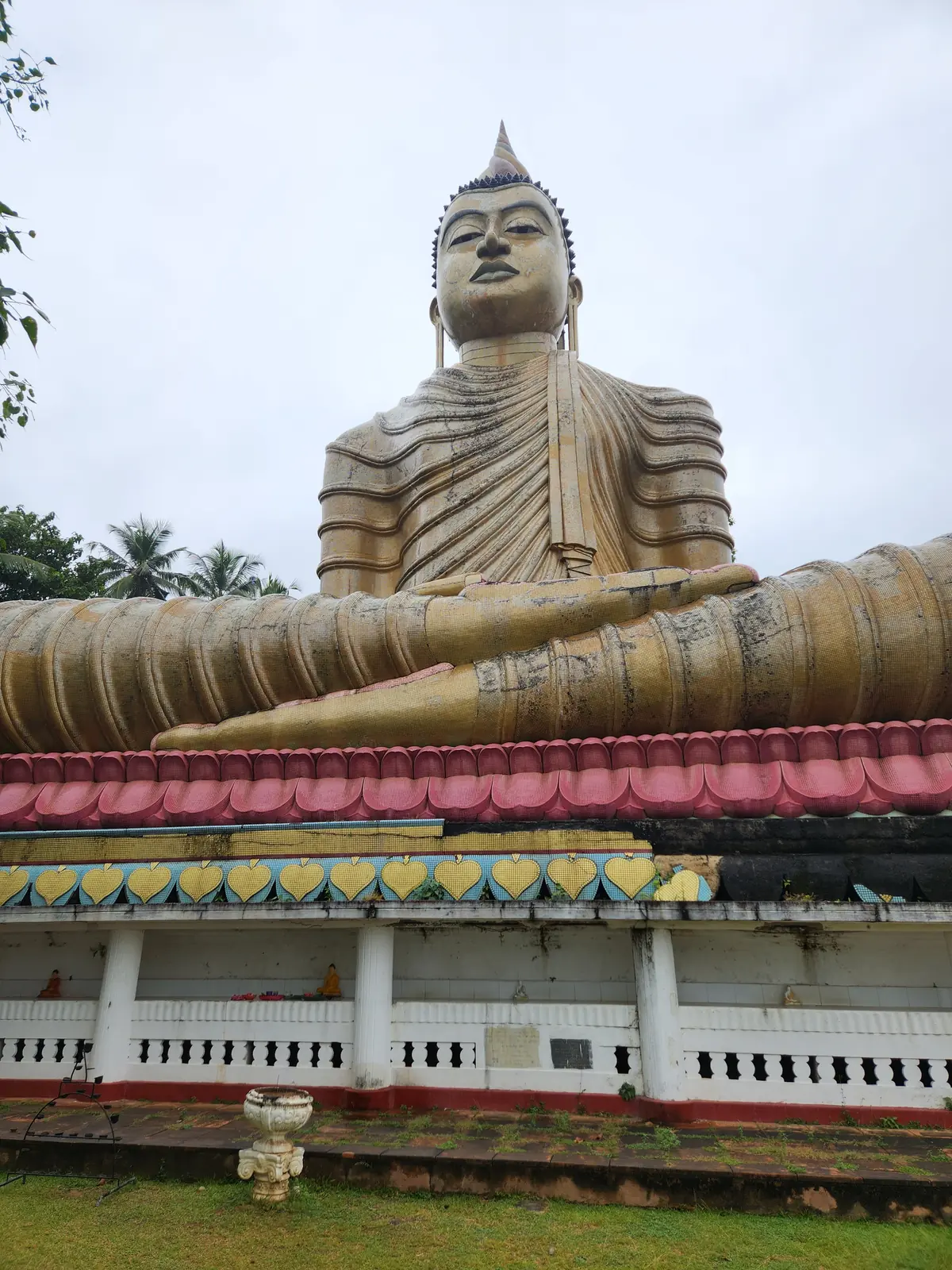
Almost all English-language coverage of Buddhist temples in Sri Lanka is about the same four sites. All four are worth visiting and all four are thoroughly documented elsewhere. What is not documented is what the other several thousand temples are like — and those are the ones you actually pass on any drive through the hill country.
A small hill temple differs in specific ways:
- Built along a ridge, not to a plan. Flat ground is scarce inland, so the compound sprawls along whatever contour exists. The dagoba, bodhi tree and image house may sit at three different elevations connected by steps.
- The view is part of the architecture. Pavilions are positioned to frame the valley, and openings in walls line up on the hills deliberately.
- Fresh paint over antiquity. Village temples are continuously repaired and repainted by the community. Scaffolding and half-finished statues are normal — a sign the temple is in use, not neglected.
- No ticket, no queue, no guide. You take your shoes off and walk in. There may be nobody there at all.
- Monkeys. Toque macaques treat temple compounds as territory and will take an unattended bag.
How to behave inside
Beyond dress and photography, a few things are worth knowing so you’re not the person everyone notices.
- Don’t point your feet at a Buddha image. If you sit down, tuck your feet behind you rather than stretching them forward.
- Don’t point at statues with a finger. Gesture with an open hand.
- Keep your voice down. These are working places of worship with people actively praying.
- Don’t touch statues or murals.
- Step aside for worshippers. If someone is praying, don’t walk between them and the image.
- Offerings are welcome, not required. Lotus flowers are sold at entrances if you want to participate.
- Full moon days (poya) are busiest. Atmospheric, but very crowded, and alcohol is not sold nationwide on those days.
Frequently asked questions about Buddhist temples in Sri Lanka
What should I wear to a temple in Sri Lanka?
Clothing covering both shoulders and knees, with shoes and hat removed before entering. Long trousers or a sarong with a t-shirt is fine. Sarongs can usually be rented at major temples.
Can women visit temples in Sri Lanka?
Yes, with the same dress requirements as men: shoulders and knees covered, shoes off. There are no separate areas or restrictions at Buddhist temples.
How much does the Temple of the Tooth cost?
Around LKR 2,000–2,500 for foreign visitors as of 2026. Sri Lankan citizens enter free or at a reduced rate. Fees change, so confirm on arrival and bring cash.
Do I have to take my shoes off?
Yes, at every Buddhist temple, and before entering the sacred area rather than just the building. There is normally a supervised shoe deposit for a small fee. Socks are worth carrying because stone gets very hot.
Can I take photos in Sri Lankan temples?
Generally yes, but never with your back to a Buddha statue, usually without flash inside shrine rooms, and not at all in some inner chambers. Signs indicate where photography is banned.
Is a Buddha tattoo a problem in Sri Lanka?
It can be. Travellers have been refused entry or deported over visible Buddha tattoos. If you have one, keep it covered for the whole trip, not only at temples.
Which is better, Dambulla or the Temple of the Tooth?
They serve different purposes. Dambulla is more visually impressive, with the cave paintings and statues. The Temple of the Tooth is more significant religiously and more atmospheric during a pooja ceremony. Most itineraries include both.
What should I bring to a Sri Lankan temple?
A tray of flowers bought at the gate — ideally three, one for each place of worship. Small change for the shoe rack and the donation box. Socks, if you are visiting in the middle of the day.
Are Buddhist temples in Sri Lanka free to enter?
Village and hill-country temples are free; you pay only the small shoe-rack fee and whatever you leave in the donation box. Major heritage sites such as Dambulla and the Temple of the Tooth charge a foreign-visitor entry fee.
Getting the most out of Buddhist temples in Sri Lanka
The single change that improves a temple visit most is timing. Arriving at Dambulla at 8 AM instead of noon, or at the Temple of the Tooth during an evening pooja rather than a dead hour, turns a sightseeing stop into something closer to the experience the place was built for.
If you’re in Kandy in July or August, the Esala Perahera is the temple’s own festival and the biggest event in the Buddhist calendar here. For the natural side of the island, our guide to Sinharaja Rainforest covers the rainforest interior.
What separates Buddhist temples in Sri Lanka from a European cathedral or a Thai wat is the three-part structure — dagoba, bodhi tree, image house — and the expectation that you visit all three rather than picking the impressive one. Get that, plus shoes off and never turning your back on a statue, and you can walk into any of the thousands of village temples on the island without causing offence. The famous four are worth your time. The unmarked one on a hill road, empty, with the valley framed in a pavilion opening, is the one you will remember.