When travelers ask, “What do people eat in Tokelau?” the honest starting point is that almost no travelers ever ask this in person, because almost no travelers ever go. Tokelau has no airport and no harbour deep enough for ships to dock. The only way in is a 24-to-30-hour boat journey from Samoa, and the supply ship comes roughly once a month.
What that isolation produced is a food system built entirely on what three tiny atolls, Atafu, Nukunonu, and Fakaofo, can grow, catch, or store. The base is taro and breadfruit, reef fish, and coconut. And the remarkable part isn’t the food itself but the system around it, a formal redistribution practice called inati that divides every large catch across the entire village.
What do people eat in Tokelau? The three pillars
1. Taro and breadfruit: the land side of the ledger
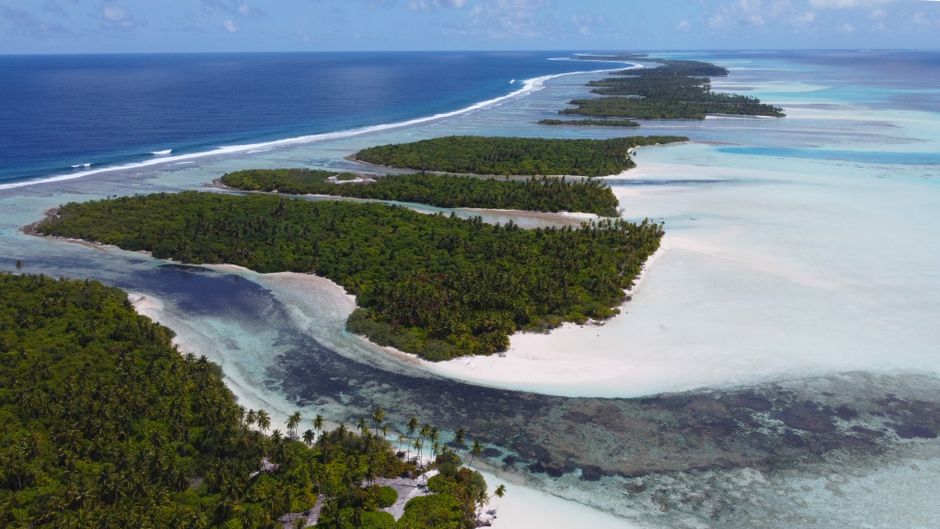
Tokelau’s atolls are coral rings around lagoons, with almost no natural soil. What little grows does so in pits dug down to the freshwater lens beneath the coral, filled with composted organic matter built up over generations.
- Taro (talo), grown in these dug pits, the traditional starch
- Breadfruit (mei), seasonal, eaten fresh or preserved
- Pandanus (fala), fruit eaten fresh, leaves used for weaving
- Coconut, both a crop and the cooking medium (see below)
- Banana, grown where there’s enough soil depth
The taro pits are a direct parallel to Kiribati’s babai pits. The same engineering solution to the same problem of growing a wet-loving crop with no rivers or standing fresh water.
2. Reef and lagoon fish: the daily protein
Each atoll encloses a lagoon, and the lagoon does most of the feeding:
- Reef fish, parrotfish, snapper, and dozens of lagoon species
- Tuna and other pelagic fish caught just outside the reef
- Octopus and shellfish gathered by hand at low tide
- Coconut crab, a delicacy, as across the Pacific
Fishing is organized communally on many days rather than left to individual households, which connects directly to how food gets distributed (see below).
3. Coconut: the tree that pays for everything else
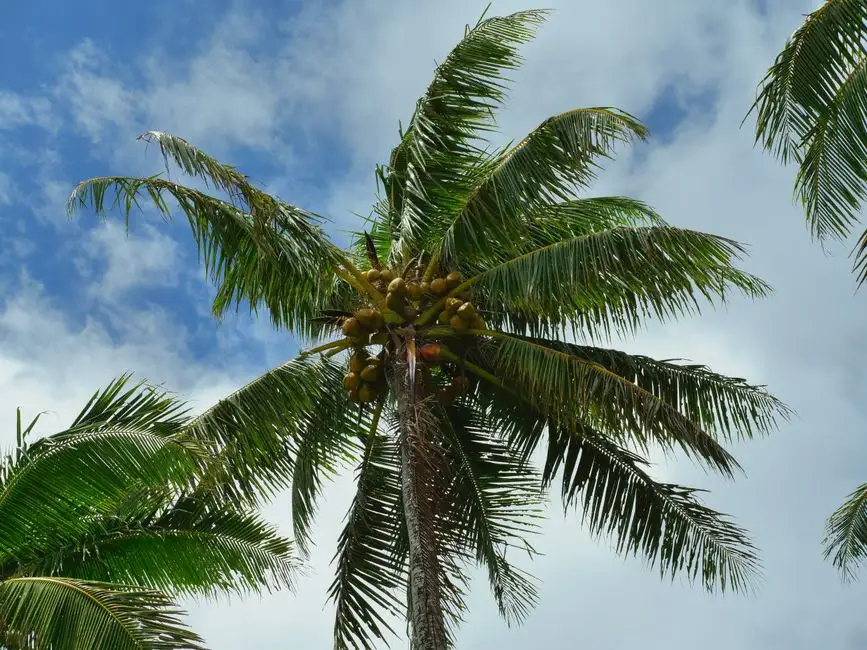
Coconut supplies food, drink, cooking fat, rope, thatch, and, critically for Tokelau’s economy, copra, dried coconut flesh sold for oil production. Copra has historically been one of Tokelau’s only exports, meaning the same tree that feeds a household also earns it cash.
Inati: the food-sharing system that makes this work
Inati, the communal food-distribution system studied by the United Nations in its work on climate-vulnerable atoll nations, is central to what people eat in Tokelau.
No account of what people eat in Tokelau is complete without inati, the traditional system of communal distribution.
The mechanics are more formal than “sharing” suggests. The Council of Elders calls an inati. The village mayor announces and organizes it. On the appointed day all able-bodied men go out to fish a targeted species, often tuna, while the women prepare food and tea for their return.
The entire catch then goes to a single distribution point. Nobody keeps what they caught. An elder calculates each household’s share according to how many people live there and their ages, and divides the fish accordingly. Larger families receive more, both in quantity and in the type of fish they get.
Every household receives a portion. The elderly, the sick, and families without a fisherman are covered automatically. Not as charity, but as arithmetic. Roles are designated, the process is public, and it has functioned this way for generations.
This is not a ceremonial gesture. On atolls this small and this isolated, with no possibility of a supermarket run if supplies fail, inati is a functioning food-security mechanism. On islands where a bad month genuinely means going without, it is the reason nobody goes hungry while a neighbour has a full boat.
Traditional dishes: what people eat in Tokelau day to day
| Dish | What it is | When it’s eaten |
|---|---|---|
| Grilled reef fish | Whole fish over coals or in coconut cream | Everyday |
| Taro with coconut cream | Boiled or baked taro, coconut sauce | Everyday, feasts |
| Breadfruit, roasted or boiled | Whole or sliced breadfruit cooked simply | Seasonal, everyday |
| Raw fish in coconut cream | Cubed fish marinated in lime, coconut cream | Everyday, gatherings |
| Coconut crab | Grilled or boiled | Delicacy |
| Fermented breadfruit | Pit-preserved for lean periods | Traditional, less common now |
| Octopus in coconut cream | Lagoon octopus stewed | Feasts |
| Pulaka-style pounded taro | Similar to neighbouring atoll traditions | Ceremonial |
Raw fish in coconut cream: the everyday dish
Tokelau’s version of the Pacific raw-fish dish uses reef fish, sometimes tuna, cubed and marinated in citrus, then mixed with thick coconut cream and whatever vegetables are on hand. Onion, tomato if available. It sits closer to the Samoan and Tongan versions than the leaner Kiribati style, reflecting close cultural and family ties to Samoa.
Fermented breadfruit: the insurance policy
Like Kiribati’s te kabubu and the preserved breadfruit traditions across Micronesia, Tokelau developed pit fermentation to store breadfruit through lean periods and storm damage. It’s eaten less today, as the monthly supply ship reduces the need for it, but older residents still maintain the technique.
How is food cooked in Tokelau?
Coconut cream stewing. The default method. Grated coconut pressed into cream, used to cook fish, taro, and breadfruit.
Open grilling. Whole fish over coals or hot stones, the simplest and most common everyday method.
Earth oven, for larger occasions. Used less routinely than in Samoa or Tonga, reflecting the smaller scale of most Tokelauan households, but still brought out for village feasts.
Pit fermentation. For breadfruit preservation, a technique shared with several other atoll nations facing the same storage problem.
What do people eat in Tokelau daily?
The reality of the supply ship
Tokelau’s food supply runs on a monthly rhythm dictated by the ship from Samoa. Rice, flour, sugar, tinned meat and fish, and other shelf-stable imports arrive in bulk and get rationed out over the following weeks.
- Early in the month: more variety, including some fresh imported items
- Later in the month: heavier reliance on local taro, breadfruit, and fish
- Throughout: reef fish and lagoon seafood as the constant protein source
New Zealand’s role
Tokelau is a dependent territory of New Zealand, and Tokelauans hold New Zealand citizenship. More Tokelauans live in New Zealand than in Tokelau itself. A pattern seen across several small Pacific nations on this list. That relationship supplies remittances, imported goods, and a steady flow of people and ideas moving both directions.
Why Tokelau matters for food security research
Chronic hunger is unusually rare in Tokelau despite conditions, minimal arable land, total isolation, extreme vulnerability to storms, that would predict the opposite.
The reasons usually given:
- Inati ensures no household is cut off from a catch entirely
- Diversified sourcing. Taro pits, lagoon fishing, pelagic fishing, and imports all operate simultaneously, so a failure in one doesn’t collapse the system
- Small, tightly bonded populations where social obligation to share is strongly enforced
- Copra income provides cash for imports even without tourism or exports beyond coconut products
This is the genuinely distinctive angle in what people eat in Tokelau. Not the dishes themselves, which resemble neighbouring atolls, but the distribution system that keeps everyone fed on some of the least productive land in the Pacific.
Climate change is a food story shaping what people eat in Tokelau
Tokelau sits a few meters above sea level. Saltwater intrusion into the freshwater lens is a direct threat to the taro pits. If salt reaches them, the crop fails and pits built up over generations become useless.
Drought is the other side of it. With no rivers, all fresh water is rainwater, collected and stored. Tokelau declared a state of emergency during a severe drought in 2011 and needed emergency water shipments.
Tokelau’s response was unusually decisive. In 2012 it became the first nation in the world to meet its electricity needs entirely from renewable energy, installing roughly 4,000 solar panels and battery banks across the three atolls. At the time one of the largest standalone solar systems anywhere.
That is a food story too. Before it, power came from diesel generators fed by the same unreliable boat that brought the rice. Reliable electricity means refrigeration, which changes what can be stored, how long fish keeps, and how much a delayed shipment actually matters.
How travelers can experience Tokelauan food
Realistically, almost none do. There is no tourist infrastructure, no airport, no regular visitor accommodation in the commercial sense, and the boat from Samoa is not a scheduled passenger service in the way ferries elsewhere are.
Visits happen through specific arrangements, government business, family connection, or research permits, rather than as tourism. If you do get access, expect to eat what the household eats: fish, taro, breadfruit, and coconut, shared under the same inati principles that govern everyone else’s meals.
If you do visit
- Bring supplies; you are one more mouth on an island where the ship comes monthly
- Eat what’s offered and understand that a share has likely come out of the inati system
- Ask before assuming anything is available on demand, supply is genuinely finite between ships
Frequently asked questions: what do people eat in Tokelau?
What is the traditional staple food in Tokelau?
Taro and breadfruit, grown in composted pits dug to the freshwater lens beneath the coral atolls, alongside coconut and reef fish as the constant protein source.
What is inati?
Inati is Tokelau’s communal fishing and distribution system. The Council of Elders calls it, the village mayor organizes it, the men fish collectively, and the entire catch is brought to one point and divided among all households according to family size and age. So every family is provided for regardless of who caught what.
Is the inati still practised today?
Yes. It remains an active part of village life across all three atolls, organized through the Council of Elders and the village mayor.
Is there hunger in Tokelau?
Chronic hunger is unusually rare given the minimal arable land, largely because of the inati sharing system, diversified food sourcing, and small tightly bonded communities.
How does food get to Tokelau?
By supply ship from Samoa roughly once a month. There is no airport and no deep-water harbour. Rice, flour, sugar, and tinned goods arrive in bulk and are used gradually over the following weeks.
Can tourists visit Tokelau?
There is essentially no tourism infrastructure. Access is through specific arrangements, government, family, or research, rather than commercial travel.
Is Tokelauan food similar to Samoan food?
Yes, closely. Tokelau has strong historical and family ties to Samoa, and dishes like raw fish in coconut cream closely resemble the Samoan version rather than the leaner styles found in Micronesian atoll nations.
Conclusion: what do people eat in Tokelau? Less variety, more security
To ask what people eat in Tokelau is to find a diet narrower than almost anywhere else in this series, taro, breadfruit, fish, coconut, and whatever the monthly ship brought, and yet a food security record that outperforms far wealthier, more diverse food systems.
The dishes are not the story here. The system that gets them onto every table, regardless of who caught the fish, is.
For a comparison with another atoll nation solving the same problem of no rivers and no soil, see our guide to what people eat in Kiribati, or read about what people eat in Niue.